Fafana Manufacturing Company Ltd, producers of special fruit juice, started business on 01/01/2016 and prepares accounts to 31 December each year. The company had constructed an office building, which was put into use on 01/01/2016. The following are the capital allowance written down values brought forward from pools of assets as at 01/01/2017:

Item Written Down Value (GH¢)
Pool 1 12,000
Pool 2 520,000
Pool 3 405,000
Office Building 540,000
Patent (acquired in 2016 for five years) 48,000

The company acquired the following chargeable assets for the business in 2017:

  • Factory Buildings GH¢958,000
  • Plant and Machinery GH¢2,500,000
  • File Cabinet GH¢10,000
  • Electric Ceiling and Standing Fans GH¢20,000
  • Window and Split Air Conditioners GH¢157,000
  • Motor Vehicles GH¢110,000
  • Photocopier GH¢14,000
  • LCD Television GH¢3,000
  • Visitors Chairs GH¢5,500
  • Office Chairs and Tables GH¢56,000

Some assets were disposed of in 2017, namely:

  • Computers and Accessories GH¢11,600
  • Standing Fans GH¢3,500

The company acquired the following chargeable assets for the business in 2018:

  • Toyota Salon Car GH¢70,000
  • Toyota Pick-up (only one) GH¢95,000
  • LCD Projector GH¢5,500
  • Data Handling Machine GH¢36,000
  • Trucks and Trailers GH¢54,000
  • Trademark (registered for 8 years) GH¢72,000

One of the vehicles was involved in an accident in 2018, and the company received GH¢45,000 as insurance compensation.

Required:
a) Determine the capital allowances for Fafana Manufacturing Company Ltd for 2017 and 2018 years of assessment. (16 marks)
b) Indicate how the class or pool system works with the treatment of capital allowances. (4 marks)

a) Computation of Capital allowance (GH¢)
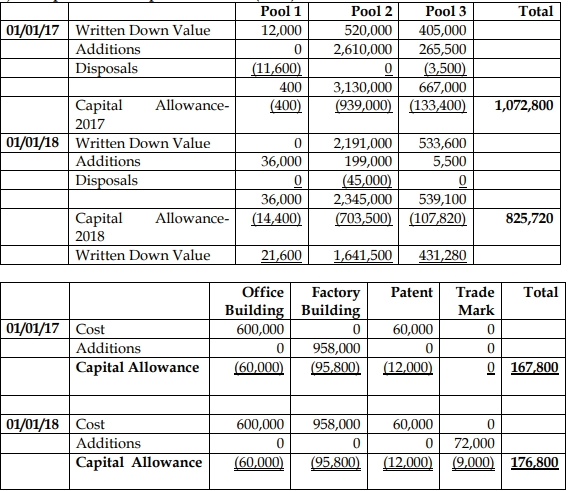
 

b) Explanation of the Class or Pool System

  • The pool system groups depreciable assets of the same class for capital allowance computation.
  • In this system, the identity of individual assets is lost as they are aggregated into pools.
  • Class 1 to 3 assets follow the pool system, while Class 4 and 5 assets (such as buildings and intangibles) are kept separately for each item.
  • Assets in a pool receive capital allowances based on the written-down value (WDV) of the pool.
  • Assets used solely for income production are placed in the pool, and any disposals reduce the pool value.