Dunning Limited has recently introduced an Activity Based Costing System and has
provided the following details for the month of January:
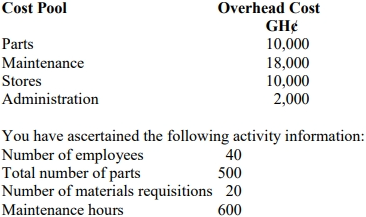
During the month, 500 units of Product Y were produced. This production run required
100 parts and 150 maintenance hours; 5 material requisitions were made and 10
employees worked on the units.
Required:
i) Using Activity Based Costing, calculate the total amount of overhead absorbed by each
unit of Product Y. (7 marks)
ii) Identify THREE different types of controls and explain how activity based costing assists
in the control of costs?

i) Product Y – Overhead Absorption

Cost Pool Workings GH¢
Parts 100 parts x GH¢20 per part 2,000
Maintenance 150 hours x GH¢30 per hour 4,500
Stores 5 requisitions x GH¢500 per requisition 2,500
Administration 10 employees x GH¢50 per employee 500
Total Overhead Absorbed 9,500
Per unit 9,500 / 500 units 19

ii) Three Types of Controls and Activity-Based Costing

Control Type Description How ABC Assists
Action or Behavioral Controls Observing individual actions to ensure they align with cost control measures, such as work studies or quality controls. ABC provides detailed information on cost drivers, which helps in identifying areas needing corrective actions.
Personnel and Cultural Controls Establishing values and norms to influence employee performance and cost efficiency. ABC helps in understanding the cost implications of various activities, which can guide training and cultural alignment.
Results and Output Controls Collection and analysis of performance data to assess the outcomes of work efforts. ABC provides accurate cost data on outputs, which helps in evaluating performance and ensuring results meet expectations.