The following list of balances was extracted from the books of Awatey at 30 April 2021:

Account Amount (GHȼ)
Sales 134,200 (Cr)
Purchases 62,300 (Dr)
Inventory at 1 May 2020 4,700 (Dr)
Discounts received 390 (Cr)
Discounts allowed 240 (Dr)
Salaries and wages 12,700 (Dr)
Rent and rates 8,100 (Dr)
Motor vehicle expenses 7,500 (Dr)
Machinery repairs 14,200 (Dr)
General expenses 2,600 (Dr)
Machinery at cost 45,000 (Dr)
Machinery accumulated depreciation 8,000 (Cr)
Motor vehicles at cost 30,000 (Dr)
Motor vehicles accumulated depreciation 6,000 (Cr)
Bank 4,400 (Dr)
Trade receivables 4,600 (Dr)
Trade payables 2,200 (Cr)
Drawings 7,400 (Dr)
Capital at 1 May 2020 52,950 (Cr)

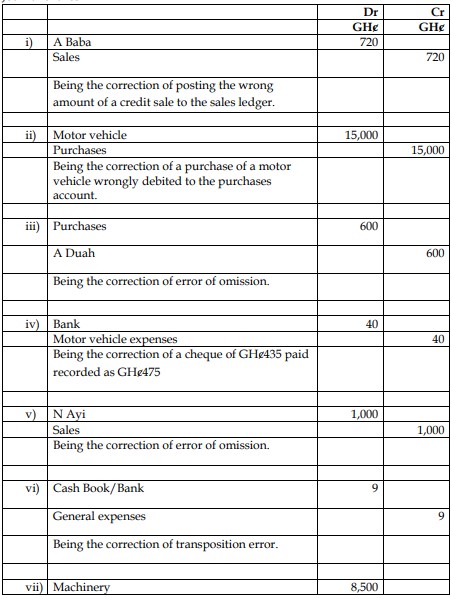
After the extraction of the above balances, the following errors and omissions were discovered: i) A sale on credit to Ali Baba of GHȼ800 had been entered in the Sales Journal as GHȼ80 and had also been posted to the Sales Ledger at the same amount. ii) A new Motor Vehicle costing GHȼ15,000 bought during the year had been debited to the Purchases Account. iii) Purchase of goods on credit from Agyemang Duah, amounting to GHȼ600, had been omitted from the books. iv) A cheque for GHȼ435 paid for Motor Vehicle expenses was recorded in the Cash Book and the Motor Vehicle Expenses Account as GHȼ475. v) Sales of goods on credit to Nii Ayi, amounting to GHȼ1,000, had been omitted from the books. vi) A cheque for GHȼ689 paid for general expenses was recorded in the Cash Book and the General Expenses Account as GHȼ698. vii) The purchase of machinery for GHȼ8,500 had been debited to the Machinery Repairs Account.

Required:
a) Prepare journal entries with appropriate narratives to correct each of the errors and omissions.
(8 marks)

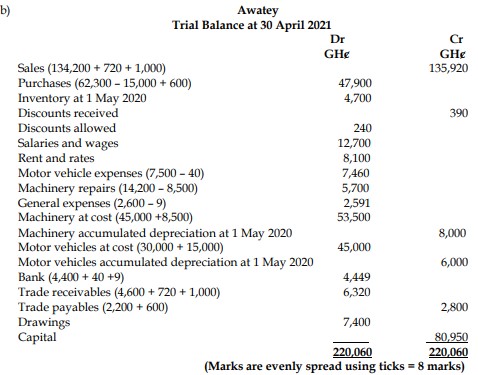
b) Prepare the Trial Balance of Awatey as at 30 April 2021 after adjusting for the errors and omissions.
(8 marks)

c) Explain TWO (2) types of errors which would not affect the balancing of a trial balance.
(4 marks)

a) Journal Entries


c)
Types of Errors Not Affecting Trial Balance

  1. Error of Omission:
    When a transaction is completely omitted from the books, neither a debit nor a credit entry is made, and thus the trial balance remains balanced.
  2. Error of Principle:
    This occurs when a transaction is entered in the wrong class of account. For example, treating a capital expenditure as revenue expenditure. The trial balance will still balance because the double entry is correctly recorded, but the transaction is misclassified.

(4 marks evenly spread)