
Question
There has been agitation to stop importation of containers from China, to increase patronage of local industries. The Board of Favour PLC is planning to acquire 75% controlling interests in either Grace Limited or Blessing Limited which produce better and cheaper containers locally. As a trainee working in
Obokun Chartered Accountants, the Managing Partner has requested you to carry out performance score cards of the companies using accounting ratios to assess the viability of the acquisition.
Statement of comprehensive income for the year ended December 31, 2020:
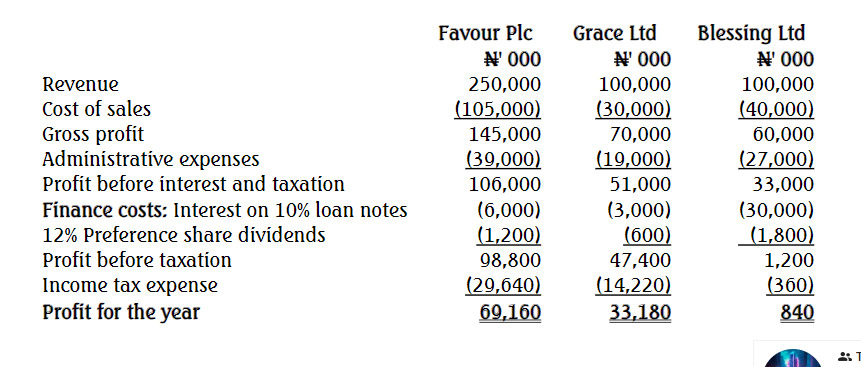
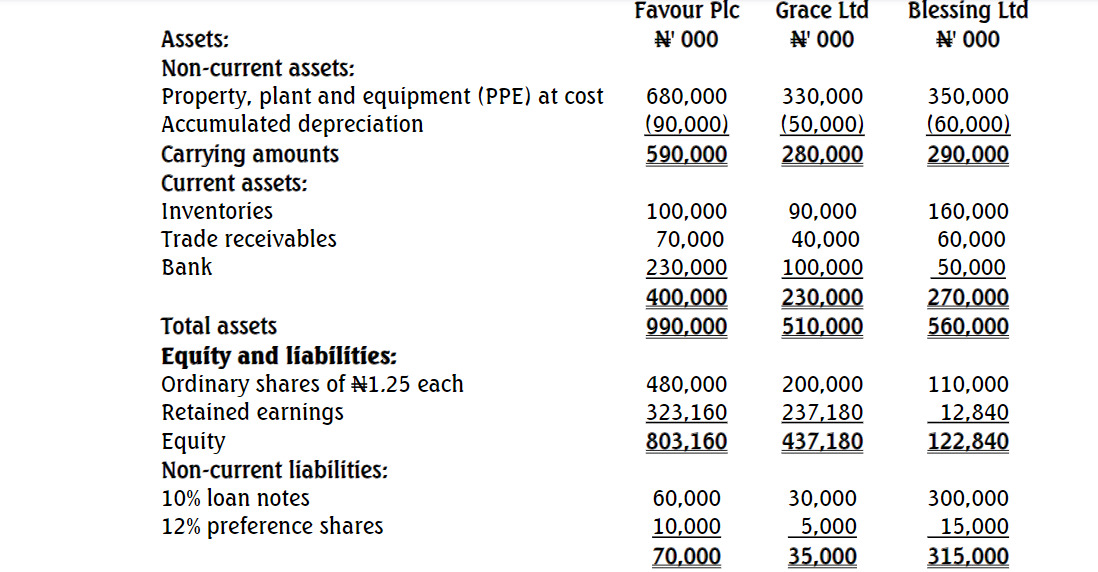

Additional Information:
(i) Inventories as at December 31, 2019 were N60 million, N30 million and N50 Million and the current market prices, 30 kobo, 28 kobo and 10 kobo
for Favour Plc, Grace Limited and Blessing Limited respectively.
(ii) Purchases for cash within 365 days in the year 2020 were 10%, 20% and 40% of cost of sales for Favour Plc, Grace Limited and Blessing Limited
respectively.
Required:
a. Calculate the following ratios for Grace Limited and Blessing Limited.
i. Net profit margin
ii. Quick ratio
iii. Debt equity ratio
iv. Proprietary ratio
v. Earnings yield
vi. Net asset per share
b. Draft a technical report titled “Performance Scorecard‟ of Blessing Limited and Grace Limited and advise Favour Plc in which of the two companies it should acquire 75% controlling interests. (10 Marks)
c. The Chief Financial Officer (CFO) of Favour Plc noted that the records of Blessing Limited and Grace Limited are maintained using block chain technologies.
Required: Discuss the type of records that a company can maintain in blockchain and state TWO benefits of making use of this technology. (10 Marks)
Answer
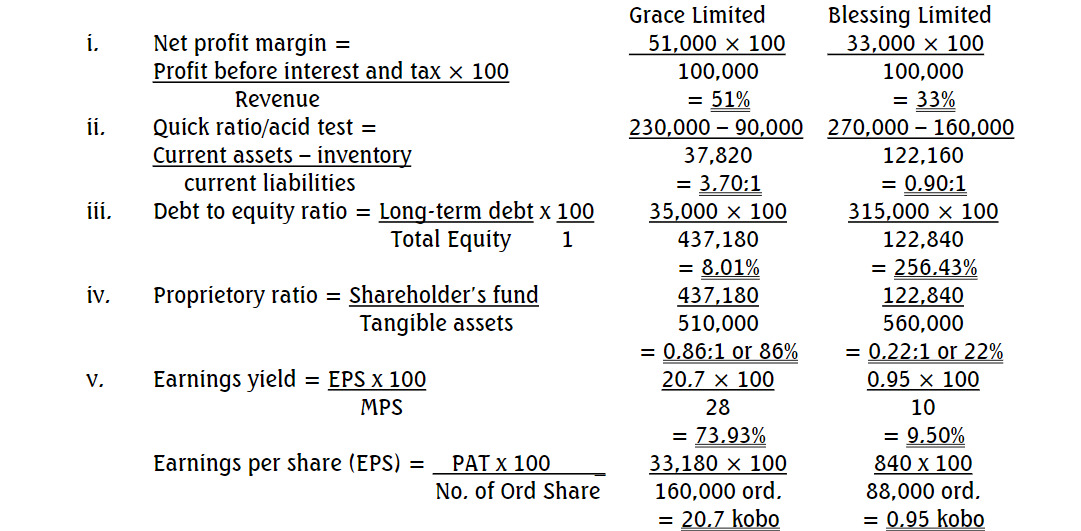
(a) Computation of relevant accounting ratios for Grace Limited & Blessing Limited

SUBJECT: Analysis of financial performance scorecard of Blessing Limited and Grace Limited
Further to the request to carry out performance scorecard of the above two
companies, using accounting ratios, to assess the viability of their acquisition,
the following findings have been made:
Profitability performance of the two companies
i. Based on the computed net profit margin of the two companies, the net profit margin of Grace Ltd is 51% while that of Blessing Ltd shows 33%, indicating that Grace Ltd is more profitable than Blessing Ltd.
ii. The profitability level of Blessing Ltd is seen to be too low. This was probably due to poor control of overhead by Blessing Ltd since the two
companies almost have the same gross profit.
iii. In addition, the earnings yield of Grace Ltd is high, 73.93% while that of Blessing Limited is 9.5%. This is an indication that Grace Ltd is likely to provide shareholders of Favour Plc more returns than Blessing Ltd.
Liquidity position of the two companies
i. With reference to the computed quick ratio of the two companies, it can be deduced that Grace Ltd is more liquid than Blessing Ltd. The quick
ratio of Grace Ltd is 3.7:1 while that of Blessing Ltd is 0.9:1.
ii. This indicates that Grace Ltd will be more comfortable in meeting its short-term debt obligations than Blessing Ltd.
Gearing and solvency position of the two companies
i. Based on the computed debt to equity ratio, it is obvious that the gearing level of Grace Ltd is better than that of Blessing Ltd. Grace Ltd‟s gearing ratio is 8.01% which is within the acceptable range, while Blessing Ltd‟s gearing ratio is 256.43%. This shows that Blessing Ltd is highly geared and high risk to invest in.
ii. In addition, the proprietary ratio computed for the two companies indicates that the shareholders in Grace Ltd would be more secured and protected in the case of liquidation, compared to Blessing Ltd that has a lower proprietary ratio of 22%. Furthermore, the net asset per share of Grace Ltd is higher than that of Blessing Ltd, indicating that Grace Ltd is more solvent and financially stable.
Conclusion
However, in view of the fact that Grace Ltd will be capable of utilising its resources more efficiently and considering the fact that it is a highly profitable company with a fairly suitable liquidity position we would advise that, the directors of Favour Plc should acquire 75% interest in Grace Ltd.
Recommendations
Further information that may be useful to the board of directors of Favour Plc
when making acquisition decisions are:
i. In this case, the analysis has been made on the draft financial statements. These may be unreliable or change when finalised. Audited financial statements would add credibility;
ii. Other relevant information should be considered, for example profit forecasts, cash budgets, capital expenditure budget and future prospects;
iii. There would be need to ascertain current (fair) value of assets to be acquired;
iv. The level of risks and uncertainties within the business industry should be considered;
v. The purchase consideration and mode of payment for the acquisition should also be considered;
vi. Tax implication should also be considered; and
vii. Competitive advantage; and management quality of the target entity.
Do not hesitate to contact me for any area of this report that requires further clarification.
Thank you.
Trainee Accountant
(c) Types of records that are maintained in block chain
The following are the type of records that a company can maintain in block
chain:
i. Ledger: It is used to record financial and non-financial transactions in an open, secured and decentralised ledger;
ii. Auditing records: It helps in keeping financial transactions transparent and auditable;
iii. Inventory records: It makes the transaction records of inventory accessible to authorised users at any time and location; and
iv. Banking records: It enables quick funds transfer, recording of financial transactions accurately, recording smart contracts, protecting and transferring ownership of assets, verifying people’s identities and credentials, and much more.
Benefits of making use of blockchain technology
The following are the benefits of blockchain technology:
i. It will benefit businesses by reducing costs, increasing traceability and enhancing security; ii. It allows for the encryption of data through blocks, which track the time and date of a transaction;
iii. The technology could be used to make audit process more efficient, because it would keep an accurate record of when a transaction occurred and who authorised it; and
iv. It would limit the chances of an electronic record being altered.