
Question
Answer
a) The key stages in the Capital Investment decision-making process are as follows:
- Identifying Investment Opportunities:
The first stage involves identifying potential investment opportunities. This could come from various sources such as the analysis of the business environment, research and development activities, or strategic objectives of the company. - Screening Investment Proposals:
Once potential investments have been identified, the next stage involves screening these proposals. This is done to ensure that the investment opportunities align with the available capital resources and the strategic objectives of the company. - Analyzing and Evaluating Investment Proposals:
At this stage, the selected investment proposals are subjected to thorough analysis and evaluation. This involves assessing the profitability, risk, and return associated with each investment. The evaluation may include various financial appraisal techniques such as Net Present Value (NPV), Internal Rate of Return (IRR), and Payback Period. - Approving Investment Proposals:
After analysis, the investment proposals that meet the required criteria are passed on to the relevant level of authority for approval. The decision to approve or reject a proposal is usually based on the recommendations from the analysis. High-value investments may require approval at the board level. - Implementing and Monitoring the Investment:
Once an investment proposal is approved, the necessary resources are allocated for implementation. The investment is then monitored continuously to ensure that it delivers the expected outcomes. This stage also involves reviewing the performance of the investment and making adjustments as necessary.
(Marks allocation: 1 mark for each stage = 5 marks)
b)
i) Computation of the discounted payback period:
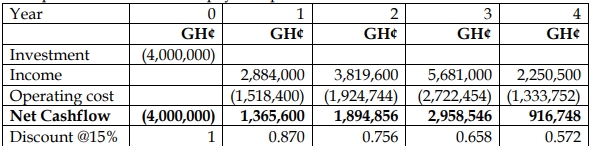

Net Present Value: GH¢1,091,686
Discounted Payback Period: 2 + (1,379,417/1,946,723) = 2.71 years
(Marks are evenly spread using ticks = 5 marks)
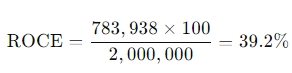
ii) Return on Capital Employed (ROCE):
Total Accounting Profit:
Year 1=GH¢1,365,600
Less Total Depreciation (Total cost since no scrap value): GH¢4,000,000
Net Profit: GH¢3,135,750
Average Profit:


ROCE
c) Categories of Financial Markets:
- Money Market:
Money markets are financial markets where short-term financial instruments are traded, typically with a maturity of one year or less.
Examples: Government treasury bills, Commercial papers. - Capital Market:
Capital markets are financial markets where long-term financial instruments are traded, typically with a maturity of more than one year.
Examples: Government bonds, Corporate bonds, Equities.
(Marks allocation: 2.5 marks for each market category with examples = 5 marks)