
Question
The following Profit or Loss Account and Statement of Financial Position relate to Dombo Ltd for the year ended 31 December 2018 (with comparative figures for the year ended 31 December 2017 where relevant).
Summarised Profit or Loss Account for the Year Ended 31 December 2018
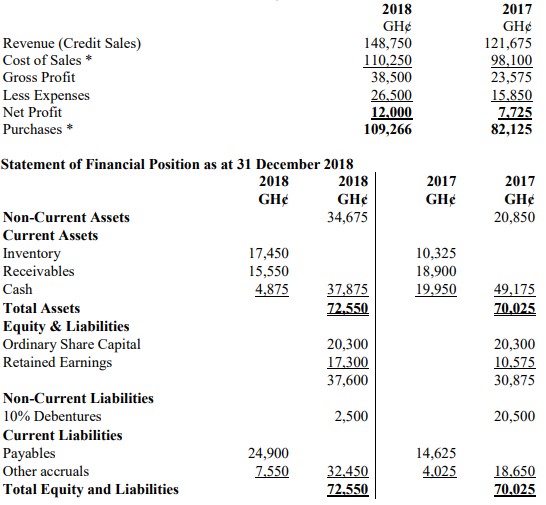
Required:
a) Calculate TWO (2) ratios each for the year ended 31 December 2018 and 2017 respectively in the following categories:
i) Profitability
ii) Liquidity
iii) Efficiency
(9 marks)
b) State FOUR (4) advantages and TWO (2) disadvantages of ratio analysis. (6 marks)
c) Explain the responsibilities of the directors and the external auditors towards the financial statements of a company. (5 marks)
Answer

b) Advantages and Disadvantages of Ratio Analysis
Advantages:
- Simplification of Financial Statements: Ratios condense large amounts of financial data into comprehensible figures, aiding in analysis.
- Facilitates Trend Analysis: Ratios help in identifying trends over time, enabling stakeholders to assess the company’s performance trajectory.
- Benchmarking: They allow comparisons with industry averages or competitors, highlighting relative strengths and weaknesses.
- Decision-Making Aid: Ratios assist management and investors in making informed decisions regarding operations, investments, and creditworthiness.
Disadvantages:
- Historical Data: Ratios are based on historical financial statements and may not accurately predict future performance.
- Different Accounting Policies: Companies may use varying accounting methods, making direct comparisons potentially misleading.
(6 marks)
c) Responsibilities of Directors and External Auditors
Directors:
- Preparation of Financial Statements: Directors are responsible for the preparation and fair presentation of the company’s financial statements in accordance with applicable accounting standards and laws.
- Maintaining Accounting Records: They must ensure that proper accounting records are kept, reflecting the company’s transactions accurately.
- Internal Controls: Directors are tasked with establishing and maintaining effective internal controls to safeguard the company’s assets and prevent fraud.
- Going Concern Assessment: They must assess the company’s ability to continue as a going concern and disclose any uncertainties.
External Auditors:
- Audit Opinion: Auditors are responsible for expressing an independent opinion on whether the financial statements give a true and fair view and are free from material misstatement.
- Compliance Check: They assess compliance with relevant accounting standards and legal requirements.
- Risk Assessment: Auditors evaluate the company’s internal controls to determine the nature, timing, and extent of audit procedures.
- Reporting: They communicate audit findings to the company’s management and, where necessary, to regulatory bodies.