
Question
Answer
a) The Relevant Costs for Determining the EOQ:
The two most relevant costs for determining the EOQ are:
- Holding Costs:
- Opportunity cost of investment in stock.
- Incremental insurance cost.
- Incremental warehouse and storage cost.
- Incremental material handling cost.
- Cost of obsolescence and deterioration of stock.
- Ordering Costs:
- Clerical cost of preparing purchase orders.
- Receiving deliveries.
- Paying invoices.
b) The Three Motives for Holding Stock:
- Transaction Motive:
- This occurs when there is a need to hold stocks to meet production and sales requirements, which cannot be met instantaneously.
- Precautionary Motive:
- This motive arises when a firm decides to hold additional stock to cover the possibility of underestimating future production and sales requirements or when the supply of raw materials may be unreliable.
- Speculative Motive:
- When it is expected that future input prices may change, a firm might maintain higher or lower levels of stock to speculate on the expected price changes. For example, if input prices are expected to rise, management should stock up to take advantage of input price savings.
c) Explanation of Economic Order Quantity (EOQ) and Its Relevance:
Economic Order Quantity (EOQ) is the ordering quantity at which the total cost of holding and ordering inventory is minimized. It represents the most economical quantity to order to minimize both incremental holding costs and ordering costs.
Relevance of EOQ:
- Optimal Use of Resources:
- EOQ ensures the optimal use of resources by minimizing costs associated with inventory management.
- Minimization of Stockouts and Overstocking:
- EOQ helps minimize the occurrence of stockouts and excessive holding of stock, which can lead to customer dissatisfaction, deterioration of inventory, and losses due to overstocking.
d) EOQ Calculation for Quaku Manu Limited:
Determine the Economic Order Quantity (EOQ):
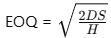
Where:
D= Annual demand = 200,000 units
S = Ordering cost per order = GHS 200
H = Holding cost per unit = 5% of unit price
To find the unit price, we use the following:
Selling price per unit =
Markup is 25% on cost, so X+0.25X=100
1.25X=100

Therefore, holding cost per unit = 5% of GHS 80 = GHS 4

2. Annual Ordering Cost:
Annual ordering cost = 
3. Annual Holding Cost:
Annual holding cost = 
4. Number of Orders per Year:
Number of orders per year =
5. Purchase Value per Order Quantity:
Purchase value per order = EOQ Purchase price per unit
Purchase value per order = 4,472 × GHS 80 = GHS 357,760