
Question
Answer
a)
i) Identification of the type of cash flow pattern described under each option.
There are three main cash flow patterns: single amount, series of even cash flows, and mixed cash flows. A single amount is when there is a one-off (or bullet or lump sum) payment over the period under consideration. A series of even cash flows is where the same amount of payment is made within the same time interval over the period under consideration. Series of even cash flows could be annuity due, ordinary annuity, or perpetuity. A mixed cash flow (or series of uneven cash flows) is where different amounts are paid in the periods under consideration.
- The cash flows under Option 1 follow the pattern of a mixed cash flow. The payments comprise an initial amount and an ordinary annuity occurring in quarterly intervals.
- The pattern of the cash flows under Option 2 is that of a series of even cash flows as there are equal amounts occurring within the time interval. Specifically, the cash flows form an annuity due because the same amount will be paid at the beginning of each of the payment periods.
(3 marks)
ii) Computation of the PV of payments under each option and advice
Option 1
The PV of payments under Option 1 is the down payment of GH¢1.2 million plus the PV of the ordinary annuity of GH¢50,000:
PV=Down PMT+PMT
PV=GH¢1,200,000+GH¢50,000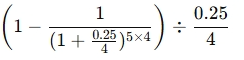
PV=GH¢1,200,000+GH¢562,036.03
PV=GH¢1,762,036.03
Option 2
As an annuity due, the aggregate PV is the first payment in the series plus the PV of the subsequent payments:
PVAD=PMT0+PMT
PVAD=GH¢55,000+GH¢55,000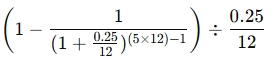
PVAD=GH¢1,912,889.33
Advice:
Based on the PVs, Option 2 is the better payment option for TekApps. However, it is worth noting that the computations are on the assumption that the required rate of return will remain at 25% throughout the five-year period. Should the average interest rate rise substantially in the economy, Option 2 might no longer be the better payment option as much of its cash flows will be discounted heavily at a rather higher required rate of return.
1 mark
b)
i) The benefits of credit rating to borrowing firms.
- Raising Capital in International Markets: Credit rating is beneficial to borrowing firms in several ways. One main benefit is the opportunity to raise capital in the international capital markets. Global capital markets and book runners would facilitate international bond issues like Eurobonds from issuers that have a credit rating, which is critical for assessing the bond’s default risk, influencing the yield on the bond.
- Fair Interest Rates: Another benefit of credit rating is the fairness in determining market yield and interest rate. With a credit rating, the borrowing firm has a greater assurance that the market required return on its debt issues would be appropriate for its default risk.
(4 marks)
ii) Factors the rating agency would consider
Rating agencies consider several factors in determining the credit rating of a security issuer. The main factors are explained below:
- Country Risk: The risk associated with the country where the company is domiciled. Based on the “sovereign ceiling” concept, private issuer’s debts are commonly not rated higher than the rating of the country of origin. Thus, the credit rating of BKB would not be better than the credit rating of the country in which it is located.
- Universal/Country Importance: The standing of the issuer relative to other companies in the country or globally. If BKB’s relative importance in its country of origin and the world is low, it would be handed a lower rating; otherwise, it would be assigned a higher rating.
- Industry Risk: The strength of the company’s industry within its country of origin. If BKB’s industry is considered a resilient industry, a higher credit rating may be assigned to it. And if it is considered to be operating in a cyclical industry, it may be handed a lower credit rating.
- Earnings protection: The ability of the company to maintain earnings in changing
situations. Earnings protection is influenced by the diversity in income sources.
High earnings power and diversity enhances an issuer’s credit rating. - Financial leverage: The extent of debt usage in the financing structure of the issuer.
A high debt to assets ratio suggests a high default risk. If BKB’s financial leverage
is high, it would be assigned a lower credit rating; otherwise, it would be assigned
a higher credit rating. - Cash flow adequacy: The ability to generate adequate cash flows to cover financial
obligations and business cash needs. If BKB generates sufficient cash flows, it
would have adequate coverage for debt payments. And that would boost its
chances of receiving a relatively higher credit rating. - Financial flexibility: The ability of the issuer to raise needed funds from varied
sources even under stress. High financial flexibility enhances credit rating
6 marks