- 20 Marks
Question
a) Eleven years ago, Mr. and Mrs. Akolgo signed onto a joint life insurance policy, which pays out benefits to the surviving spouse when one of them dies. Mrs. Akolgo died a couple of months ago, and Mr. Akolgo has applied for the payment of benefits due him.
He has been presented with three pay-out options to choose from:
Option A: A lump sum payment of GH¢400,000 now.
Option B: A payment of GH¢100,000 now plus quarterly payments of GH¢22,000 at the end of each quarter over the next ten years.
Option C: A monthly payment of GH¢10,000 for life.
The average interest rate in the economy is 25 % per annum.
Required:
Using relevant computations, recommend to Mr. Akolgo the best pay-out option. (6 marks)
b) Gaazie Mining Company (Gaazie) borrows GH¢5 million at a compound interest rate of 28% per annum for five years. Per the terms of the loan agreement, Gaazie will pay interest on the loan monthly over the life of the loan and then make a bullet payment for the principal of the loan at the end of five years.
The managers of the company have decided to deposit equal annual amounts in an interest-bearing savings account to raise money to pay off the loan principal in five years’ time. Interest on the deposits will be paid at a compound rate of 15% per annum.
Required:
Compute the annual deposit Gaazie needs to pay into the savings account. (4 marks)
c) Tofiakwa Ltd is expecting the following in six months’ time:
Receipt: US$700,000
Payment: US$1,200,000
The spot exchange rate between the Ghanaian cedi and the U.S. dollar is currently GH¢11.1255(buy) – GH¢11.5581(sell) to US$1. The cedi-dollar exchange rate has been volatile in recent times, hence the managers of the company have decided to manage the company’s U.S. dollar exposure using a money market hedge.
The following data has been gathered from the Ghanaian and the U.S. money markets:
| 6-month interest rates | Borrowing | Investing |
|---|---|---|
| U.S. dollar | 10.00% | 8.00% |
| Ghanaian cedi | 25.00% | 18.00% |
Required:
i) Set up or construct the money market hedge for the currency exposure. (3 marks)
ii) Calculate the net outcome of the hedge. (7 marks)
Answer
a) Best Pay-out Option for Mr. Akolgo:
- Option A: Lump Sum Payment
Since it is a lump sum to be paid now, it is already in its present value (PV), which is GH¢400,000. - Option B: Quarterly Payments
The present value is the sum of the immediate payment and the present value of the quarterly payments.
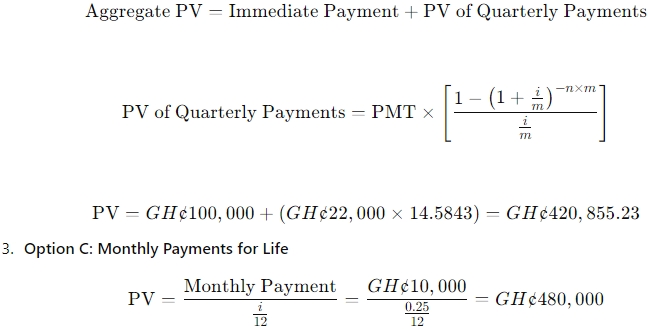
Recommendation: Option C is recommended as it provides the highest present value.
(Marks allocation: Computation for Option B = 3 marks; Computation for Option C = 2 marks; Recommendation = 1 mark)
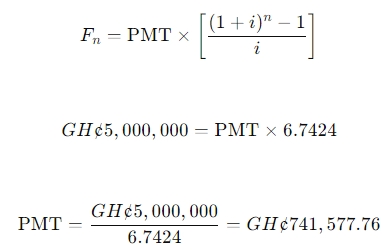
b) Annual Deposit for Sinking Fund:
The future value of the fund (F) should be equal to the principal to be repaid in five years’ time: F5=Principal Repayment5=GH¢5,000,000
c) Money Market Hedge Setup and Outcome:
i) Setup:
- The underlying exposure is a US$500,000 net payable (payment minus receipt), which is a liability.
- Position in International Money Market: Invest US$ at the investing rate of 8%.
- Position in Domestic Money Market: Borrow cedis at the cedi borrowing rate of 25%.
(3 marks)
ii) Evaluation of the Outcome:
- Borrow cedi equivalent of the present value of the US$ net payable:
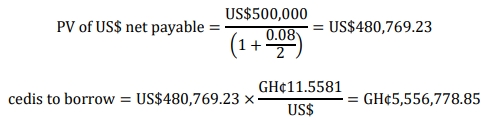
**The offer rate is used as dollars will be bought with the cedis borrowed. - Invest the US$480,769.23 bought at the US$ investing rate
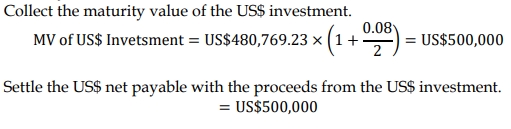
- Settle the US$ net payable with the proceeds from the US$ investment:

Net Outcome: The money market hedge results in a net cost of GH¢6,251,376.21
- Tags: Life insurance policy, Money market hedge, Present Value, Sinking Fund
- Level: Level 2
- Topic: Introduction to Investment Appraisal
- Series: NOV 2023
- Uploader: Theophilus