Hopeful Limited, a manufacturing company, has been having declining profits and liquidity problems since 2010. The company changed its accounting year-end in 2010 from 31 May to 31 December.

The shareholders injected ₦10 million into the company in January 2011, which boosted its profits in 2011 and 2012.

Even with the increase in profits in 2011 and 2012, the Managing Director was of the opinion that it is better to cut the company’s losses, once and for all, by winding-up the company. However, the Finance Director disagreed and argued that since the company’s performance was now improving, it should continue to operate.

The Company’s Accountant has prepared the financial statements and the following are extracts:

Year Profits (₦)
Year ended 31 May 2009 540,000
Year ended 31 May 2010 300,000
Seven months to 31 December 2010 645,000
Year ended 31 December 2011 1,575,000
Year ended 31 December 2012 1,876,500

The Chairman of Hopeful Limited invited you to his office on 12 June 2013, to educate him on the two concepts of change of accounting date and cessation of business as well as their tax implications.

Required:

a. Identify the steps involved in the event that HOPEFUL Limited adopts the change of accounting date. (6 Marks)
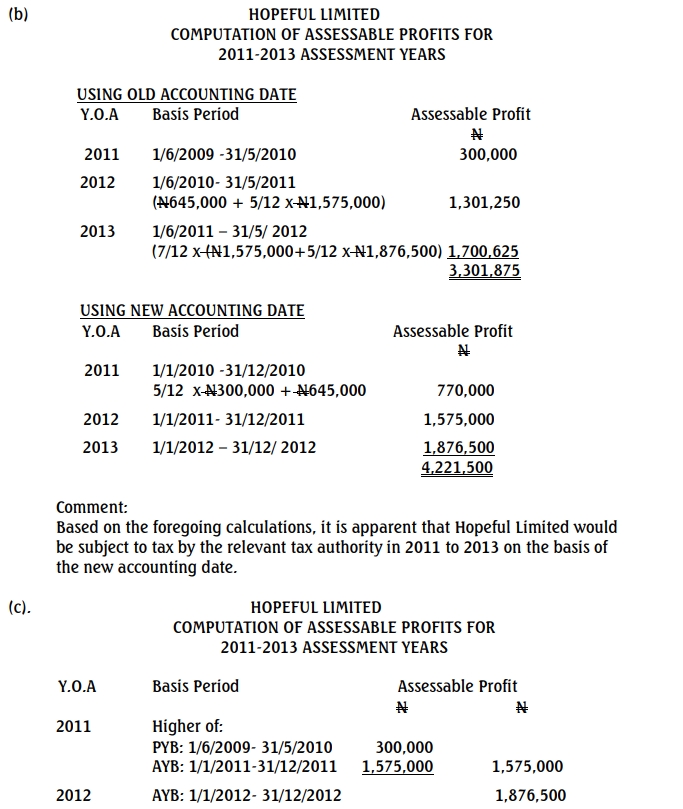
b. Compute the Assessable profits for 2011 – 2013, if the option to change accounting date is accepted, using both the old and the new dates. (7 Marks)
c. Compute the Assessable profits for the relevant years if the cessation option is accepted using the normal basis and the revised basis of assessment. (7 Marks)

a. Steps Involved in the Event that HOPEFUL Limited Adopts the Change of Accounting Date (6 Marks)

  1. Board Resolution: A resolution must be passed by the Board of Directors authorizing the change of accounting year-end.
  2. Notification to Regulatory Authorities: Notify the Federal Inland Revenue Service (FIRS) of the change in accounting date, specifying the reasons for the change.
  3. Preparation of Financial Statements: Prepare financial statements covering the transitional period. This would include statements for the short accounting period from 1 June 2010 to 31 December 2010.
  4. Adjustments for Tax Purposes: Calculate the assessable profit for the transitional period and subsequent accounting periods based on the new year-end.
  5. Approval from FIRS: Obtain approval from the FIRS for the change in accounting date. This involves submitting the application along with the revised financial statements and justification.
  6. Amendment of Tax Returns: Amend any tax returns that may be affected by the change in accounting date, ensuring proper alignment of profits, expenses, and deductions.