
Question
Answer
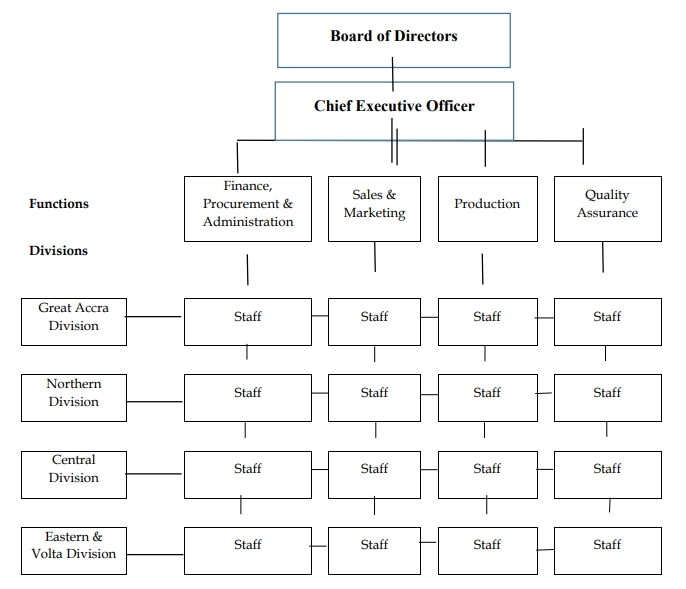
a) The appropriate structure as envisaged by the new CEO is a matrix organisational structure. A matrix structure combines different structural dimensions simultaneously, for example, product divisions and geographical territories or product divisions and functional specialisms or geographical divisions (as in the case of TCWL) and functional areas. A matrix organisation has been defined as: ‘any organisation that employs a multiple command system that includes not only a multiple command structure but also related support mechanisms and an associated organisational culture and behaviour pattern’ (Davis and Lawrence 1977).
In matrix structures, staff typically report to two managers rather than one. This dual reporting makes matrix structures complex, but they can be effective responses to today’s complex environments. A matrix structure is an organisational design in which vertical and horizontal flows of authority and communication (hence the term matrix) are created whereby functions are horizontally arrayed and divisions, products, or projects are vertically arrayed. In contrast, functional and divisional structures depend primarily on a vertical chain of command and authority.
A matrix structure is an attempt to increase organisational flexibility to meet the needs of a rapidly changing environment. It aims simultaneously to maximise the benefits from functional specialisms that occur from the division of labour while increasing the efficiency of coordination across these functions. It involves learning new roles and modes of behaviour. In a matrix structure, an individual reports to two managers. This will include their functional head (for instance, the head of Production) and also a Sales and Marketing Manager.
The new CEO is seeking to combine four centralised functional areas (Finance, Procurement & Administration, Sales & Marketing, Production, and Quality Assurance) alongside four geographical divisions (Great Accra Division, Northern Division, Central Division, and Eastern & Volta Division). Functional managers at head office would be responsible for the major functions identified by the CEO across the entire entity – which include Finance, Procurement & Administration, Sales & Marketing, Production, and Quality Assurance. Divisional managers, on the other hand, would be responsible for the sale of TCWL products in each geographical division (Great Accra Division, Northern Division, Central Division, and Eastern & Volta Division) and for the profitability of the market or the product. This would allow the divisional managers to focus on the business within their geographical areas while the functional managers would take care of the functional activities such as finance, human resources issues, etc., in each geographical division.
Diagram:
b) Two main advantages to be realised by TCWL in adopting the matrix organisational structure:
- Improved communication: A matrix structure would encourage communication throughout TCWL because the structure ensures that functional and divisional managers work together, which is usually lacking in purely functional and divisional structures. The managers would be forced to work together in TCWL due to dual reporting, both vertically and horizontally. Employees report horizontally to their divisional managers on business-related matters, while they report vertically on functional issues to the functional heads. This encourages cooperation across different areas of the company.
- Emphasis on results and teamwork: Adopting a matrix structure would result in all managers working together to get work done within TCWL, ensuring that the company continues to gain competitive advantage. The structure avoids the weaknesses of a purely functional or divisional structure, which often divides the company into separate silos. Matrix organisations emphasize cooperation and achieving results over individual managers defending their own functions or divisions, leading to a stronger overall organisational performance.