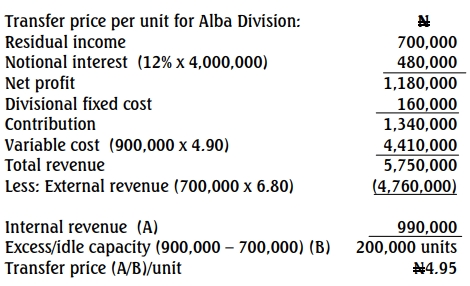
Garki plc is a holding company with four divisions, including Alba and Beta Divisions. Alba Division produces a component that it sells externally and can also transfer to other divisions within the group. Beta Division uses the components from Alba Division as raw material for its final product. The division can also obtain components from external suppliers. The components from Alba Division undergo further processing at a cost of N4.50 per unit before they are sold to the external market.

The Board of Directors has set up a performance scheme for the divisional managers, including setting performance targets for the next financial year. The following budgeted information is available:

Alba Division Beta Division
Maximum Production Capacity 900,000 units
Sales to External Customers 700,000 units
Selling Price (N) N6.80
Variable Unit Cost (N) N4.90
Divisional Fixed Costs N160,000 N140,000
Capital Employed N4 million N3 million
Residual Income N700,000 N500,000
Divisional Cost of Capital 12% 10%

Beta Division has asked Alba Division to quote a transfer price for the components.

Required:
a. Calculate the transfer price per unit which Alba Division should quote to Beta Division in order for its budgeted residual income target to be achieved. (3 Marks)
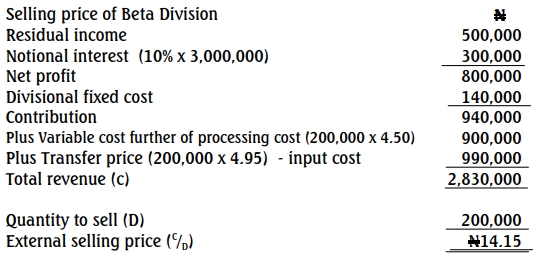
b. Calculate the selling price per unit which Beta Division should quote to the external market in order for its budgeted residual income target to be achieved, based on the transfer price quotation. (State clearly your assumptions.) (3 Marks)
c. Explain why the transfer price calculated in (a) may lead to sub-optimal decision-making from the point of view of Garki plc as a whole. (5 Marks)
d. In what circumstances would a negotiated transfer price be used instead of a market-based price? (4 Marks)

a) Garki Plc

b)

Assumption: External offer price from intermediate market from Beta Division is
equal to or greater than N4.95 transfer price.

c. Sub-optimal decision-making:

The transfer price of N4.95 may lead to sub-optimal decision-making from Garki plc’s overall perspective because Alba Division could sell the same component externally for N6.80, resulting in a loss of N1.85 per unit for internal transfers. Additionally, fixed costs and mark-up in Alba Division’s pricing lead Beta Division to incur a higher input cost, affecting overall profitability.

d. Negotiated transfer price versus market-based price:

A negotiated transfer price is appropriate when there is no perfect external market for the component or when divisions within the group have conflicting objectives. It allows managers to reach a mutually beneficial agreement, ensuring autonomy. On the other hand, a market-based transfer price is used when an external market exists, simplifying the pricing process by using the prevailing market rate.