
Question
Answer
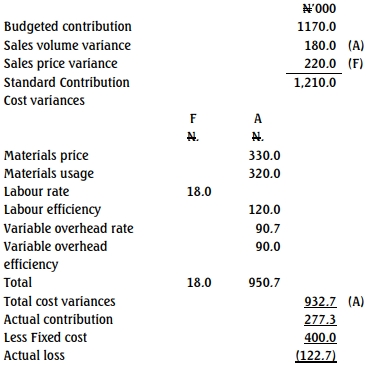
(a) Reconciliation Statement between Budgeted and Actual Profit
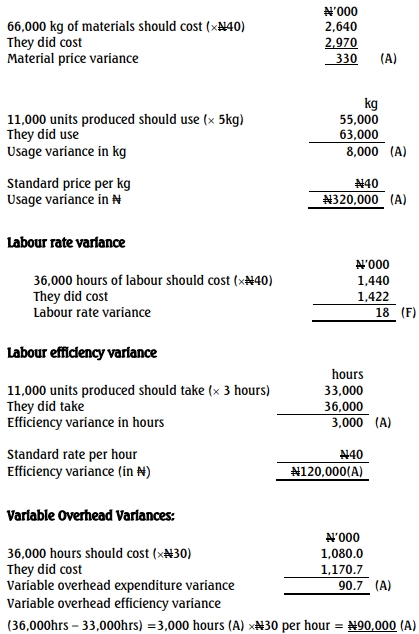
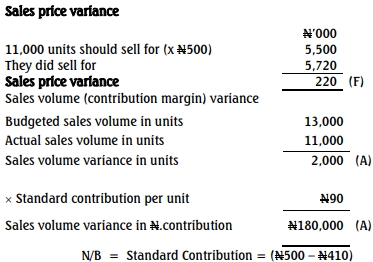
Workings
TOMA PASTE NIGERIA LIMITED
Materials price variance: based on quantities purchased since inventories are
valued at standard cost.
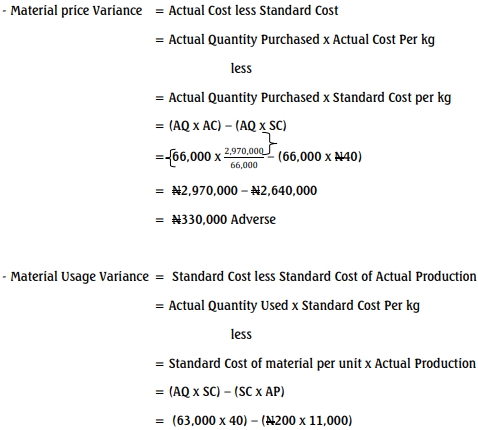
ALTERNATIVE TO COMPUTING VARIANCES
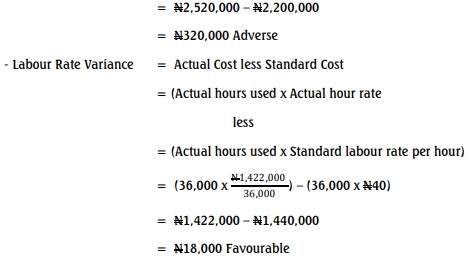
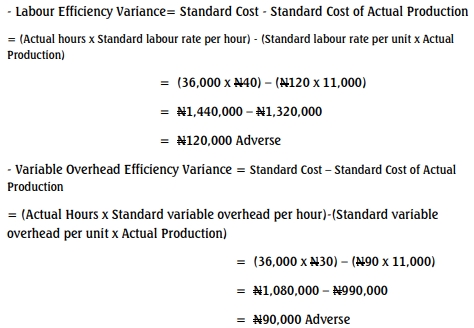
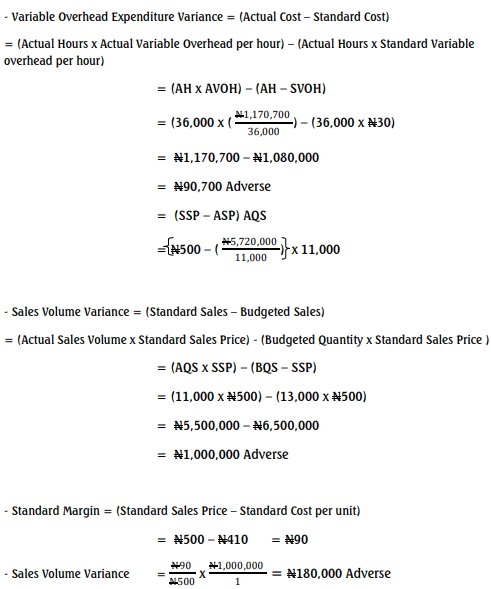
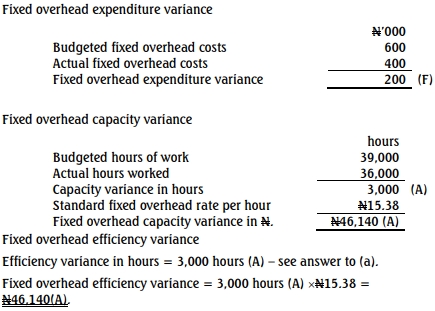
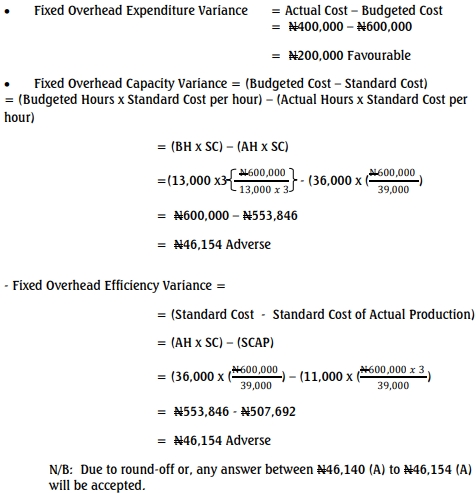
If the company uses absorption costing with a direct labour hour absorption
rate, we can calculate an expenditure, capacity and efficiency variance for
fixed production overheads.
Budgeted absorption rate per hour:
Budgeted labour hours: 13,000 x 3 = 39,000 hrs
Budgeted fixed cost N600,000
Budgeted absorption rate: N600,000 /39,000 = N15.38
ALTERNATIVE SOLUTION
(c) Labour rate
The labour rate variance is favourable indicating a lower rate per hour was
paid than expected. This is perhaps because lower grade of labour were
used during production. Though less likely, it is possible that staff had a
pay cut imposed upon them/decrease in buy rate. Finally, an incorrect or
outdated standard could have been used.
Labour efficiency
This is significantly adverse, indicating staff took much longer than
expected to complete the output. This may relate to the favourable labour
rate variance, reflecting employment of less skilled or experienced staff.
Staff demotivated by a pay cut are also less likely to work efficiently.
It may also relate to the reliability of machinery as staff may have been
prevented from reaching full efficiency by unreliable equipment. Others
include:
- Decrease in machine set up time
- Idle time
- Lack of motivation
- Faulty equipment/Machine breakdown