Lunda Limited manufactures a range of products, many of which have short product lifecycles. Research and development staff recently designed three new products which would be manufactured in a single production cell of the company’s factory. The combined monthly manufacturing overhead costs of the three products are summarized as follows:

Activity Costs (₦)
Production set-ups (10 per month) 200,000
Material movements (400 per month) 1,800,000
Repairs (4,000 per month) 3,000,000
Total manufacturing overheads per month ₦5,000,000

The following information is available concerning the three new products:
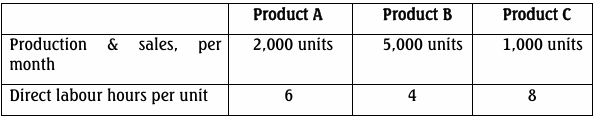
The company’s target costing task group expressed the view that the new products
would not be profitable, given the likely market prices and the cost of
manufacturing the products using the proposed design. In response, the product
designers indicated that no design changes were possible in relation to Product A
or B, but that changes in the design of Product C would bring about the following
reductions in the amount of monthly activity involved in manufacturing that
product without compromising either the quality or quantity of output:

Calculate the reduction in the cost per unit of each of the three products
which would occur as a result of the design changes to Product C, in each of
the following circumstances:
• If manufacturing overheads are allocated to products using activitybased costing (ABC);
• If manufacturing overheads are allocated to products on a direct labour
hour basis. (10 Marks)
b. Discuss the view that an ABC system is essential for the implementation of
target costing. Use the case of Lunda Limited to illustrate your answer.
(5 Marks)
c. The following data relates to another product of Lunda
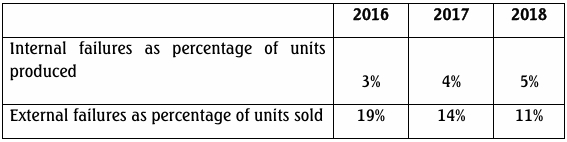
Comment on the trends in this data set. (5 Marks)


a) Cost driver rates:
• Production set-ups ₦200,000/10 = ₦20,000 each
• Materials movements ₦1,800,000/400 = ₦4,500 each
• Repairs ₦3,000,000/4,000 = ₦750 each
Cost savings (reduction in cost) as a result of the design changes:
= (2 × ₦20,000) + (100 × ₦4,500) + (1,000 × ₦750) = ₦1,240,000
If ABC is used, all of the cost savings will be traced directly to Product C. Hence,
the cost reductions will be:
• Product A: NIL
• Product B: NIL
• Product C: ₦1,240,000/1,000 = ₦1,240 per unit.
If overheads are allocated on a direct labour hour basis then the cost saving will
be spread among all three products in proportion to their labour content:
• Total DLH = (2,000 × 6) + (5,000 × 4) + (1,000 × 8) = 40,000 DLH
• Cost saving = ₦1,240,000/40,000 DLH = ₦31 per DLH
• Product A: ₦31 × 6 = ₦186 per unit
• Product B: ₦31 × 4 = ₦124 per unit
• Product C: ₦31 × 8 = ₦248 per unit
77
b) When the anticipated cost of manufacturing a product according to a particular
design is unacceptably high, a ‘target’ for cost reductions is set. These cost
reductions must be brought about by design changes to the product. Otherwise
the product cannot be manufactured.
• In the case of Luanda an ABC system is essential in order to ensure that cost
savings made as a result of changing the design of Product C are fully
reflected in the cost of the product.
• For example, if overheads are allocated on a labour hour basis then it
appears that the cost of Product C has been reduced by only ₦248 per unit.
Management may well decide that this is an inadequate reduction to justify
production of the product. ABC analysis is needed in order to show that the
cost saving is actually a much more substantial ₦124 per unit.
• Similarly, the ABC system rightly shows that there has been no change in the
cost of Products A or B (because there have been no design changes).
However, the non-ABC allocation gives the completely false impression that
the unit costs of these products have been reduced. Management might
decide that these apparent cost savings constitute sufficient grounds to begin
producing these products, even though in reality nothing has changed.
• ABC is used to get a better grasp on costs, allowing companies to form a more
appropriate pricing strategy.
• It is used for product profitability analysis.
• It ensures the cost estimates used are realistic.
• It uses overhead cost estimation
• It helps in assessing the activities that limit the production of products.
c) External failure rates have decreased considerably over time. Admittedly, this
has to some extent been accompanied by an increase in the rate of internal
failure. However, the overall trend is a positive one for two reasons:
1) The combined (internal plus external) failure rate is decreasing
2) An internal failure is less costly than an external failure. For example, an
external failure creates costs (such as loss of customer goodwill and
additional transportcosts to and from the customer’s premises) which are
avoided if the defective item is detected internally by Luanda Ltd.
It seems likely that Luanda has made some efforts to increase the effectiveness of
its internal quality control procedures. Thus, the proportion of defective items
detected internally is increasing (hence the growing internal failure rate) but the
proportion of defective items reaching the customer is decreasing.
78
It is disturbing that the vast majority of failures are still being detected by
customers rather than by the company’s internal quality procedures. As well as
trying to improve the overall level of quality, the company should try to improve
much further the effectiveness of its internal quality control procedures.

online
Knowsia AI Assistant

Conversations

Knowsia AI Assistant