
Question
Answer
a) Calculation of direct labour cost
Introduction stage
The learning curve applies throughout this stage
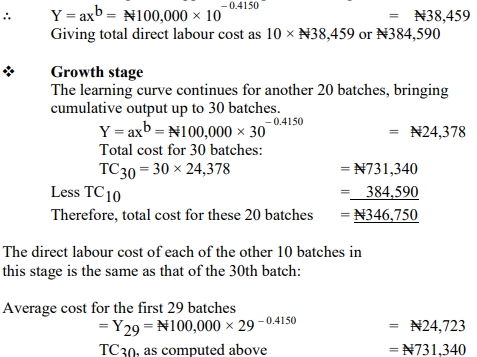
TC29 = ₦24,723 × 29 = ₦716,967
Direct labour cost for the 30th batch = ₦14,373
Therefore, the total direct labour cost for these 10 batches
= 10 × ₦14,373 = ₦143,730
Thus, the total direct labour cost for this stage of the product
life cycle is (₦346,750 + ₦143,730) = ₦490,480
Maturity stage
The learning curve effect has now ended so the direct
labour cost of these 60 batches will be:
60 batches × ₦14,373 = ₦862,380
Decline stage
The learning curve effect has now ended so the direct labour
cost of these 30 batches will be: 30 batches × ₦14,373 = ₦431,190
b)
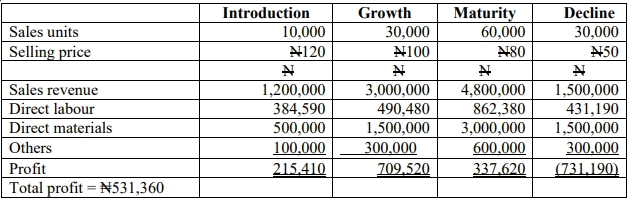
c)
Julmat Limited requires a 20% return on its average investment.
Average investment = (N5m + N3m)/2 = N4m
Profit target is therefore 20% of N4m = N800,000
As shown in the answer to (b) above, the profit predicted without the experience curve is
N268,640 less than that required (N800,000 – N531,360).
Total production throughout the products life cycle = 130 batches,
(10+30+60+30).
Currently, the total direct material cost throughout the product life cycle
= N6.5m.
This N6.5m needs to be reduced by N268,640 to N6,231,360 which is an average direct
material cost per batch of N47.934. Therefore, average direct material cost per batch
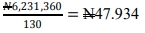
d)
The concept of life cycle costing is that the costs and revenues of a product are accumulated
over its life cycle and its overall profitability is measured, rather than separating costs and revenues into accounting periods. In this scenario, the length of the product life cycle is 12
months but this may not coincide with the company‟s accounting year.
The statement shown in solution (b) above shows the products profitability over its life cycle.
As illustrated in the scenario to this question there are four recognized stages in the life cycle
of a product. In this scenario, it appears that Julmat Limited is using a market skimming
approach to the initial launch pricing of its product because it is starting with a high price in
the introduction stage. This is then being gradually reduced over the life cycle of the
product.
The company will not only be reducing the price of the product in order to make it harder for
competitors to enter market but also to increase the demand for its product through the growth
stage. At this time, the cost of the product will also be lower than that at the launch stage due
to the effect of learning and experience curves on its labour and material costs.
In the maturity stage, the company will reduce the selling price further to consolidate its sales
and would hope that there may be further cost savings due to economies of scale though,
these are not evident from the data in this scenario.
Finally, in the decline stage, the company will have to reduce its price to sustain sales, while
under more competition from other similar products in the market, prior to launching a new
product of its own.