Ogbunigwe Nigeria Limited is a big and reputable publishing firm established in the early 1970’s. The company has recently been taken over by Wisdom International Publishing Company (WIPC) – a multinational company operating in several countries of the world.

Mr. Pampam, who is the Managing Director of WIPC, has been sent from the company’s headquarters to review, among other things, the budgeting and reporting system used by Ogbunigwe Nigeria Limited.

During his visit to all the departments, he discovered that monthly budgets are prepared for each department in the company. Upon request, the newly acquired company submitted the last budget statement for the notebook production department, which covered Quarter 3 of 2022, as shown below:

Budget statement for Quarter 3
Department: Notebook Production

Particulars Actual Results (N’000) Budget (N’000) Variances (N’000)
Direct materials 1,512 1,440 (72)
Direct labor 738 720 (18)
Variable production overhead 474 432 (42)
Fixed production overhead 354 336 (18)
Variable administrative overhead 246 240 (6)
Fixed administrative overhead 300 288 (12)
Total costs 3,624 3,456 (168)
Sales value of production 4,650 4,464 186
Profit 1,026 1,008 18

The Head of Department of the notebook production department, Mr. Josiah Okoli, commented on the state of affairs of the department. He revealed that the budget statement presented was based on 72,000 units with a standard labor processing time of 2.85 hours per unit.

Mr. Pampam observed that Mr. Josiah Okoli was not enthusiastic about the budget system. He viewed it as a pressure system imposed by the company to portray some departmental managers in a bad light. He pointed out that the system was hurriedly introduced by Dynamic Financial Konsult about twelve months ago. The consultant did not provide sufficient explanation to assist users of the budget to understand the system. Mr. Josiah Okoli expressed doubt about the competence of the consultant and believed the system was not suitable for Ogbunigwe Nigeria Limited. He even stated that his department might have actually made a loss, as against the reported profit.

This situation cuts across many departments, making it imperative and urgent to resolve the issues with the budget system. Your advice to Mr. Pampam will assist tremendously in addressing these problems.

Required:
a. Redraft the budget statement in a more informative manner, showing the relevant variances. (12 Marks)
b. State the general behavioral problems associated with budgeting, and relate these issues to this situation. (4 Marks)
c. Recommend ways to make the budgeting system more useful and acceptable in the current situation. (4 Marks)

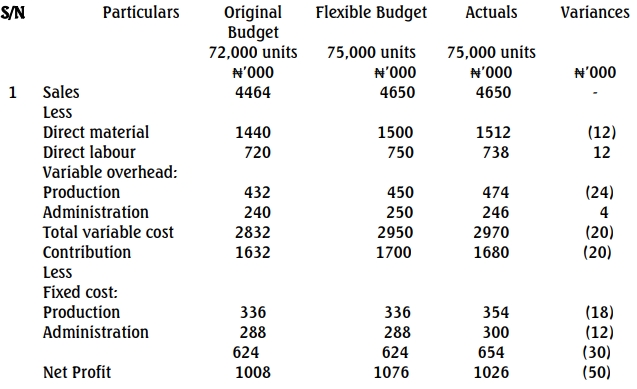
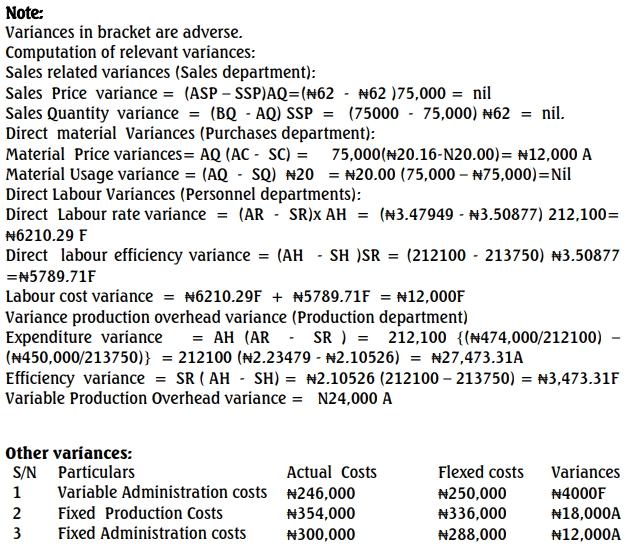
a. Redrafted Budget Statement
The redrafted statement will highlight key areas where the budget has either been over- or under-spent. Variances should also be classified as favorable or unfavorable to better understand the department’s financial performance.
b. Behavioral Problems Associated with Budgeting

  • Perceived Unfairness: Employees may feel that the budget system is used as a tool for criticism, which creates distrust and resentment, as demonstrated by Mr. Okoli’s reaction.
  • Lack of Understanding: The rushed implementation and inadequate explanation of the budget system has left managers, like Mr. Okoli, feeling alienated and skeptical about its validity.
  • Pressure to Perform: Budgeting can create excessive pressure to meet financial targets, leading to low morale and disengagement from the budgeting process.
  • Misalignment with Departmental Goals: The budget may not reflect the real operational conditions or specific challenges faced by departments, leading to frustration among department heads.

c. Recommendations for Improvement

  • Provide Adequate Training: Educate department heads on how the budget system works and ensure they understand the rationale behind it, thus fostering greater buy-in.
  • Involve Managers in the Budgeting Process: Include department heads in the creation of their budgets to ensure alignment with departmental goals and operational realities.
  • Focus on Realistic Targets: Ensure that the budget targets are achievable and reflect the current economic and operational environment to reduce pressure and boost morale.
  • Implement Rolling Budgets: Rather than relying on fixed budgets, rolling budgets should be considered to allow for adjustments based on changing market and operational conditions.