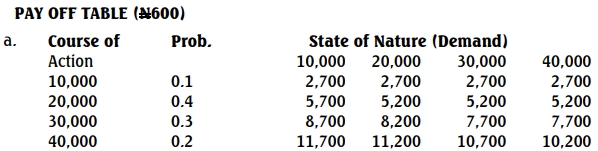
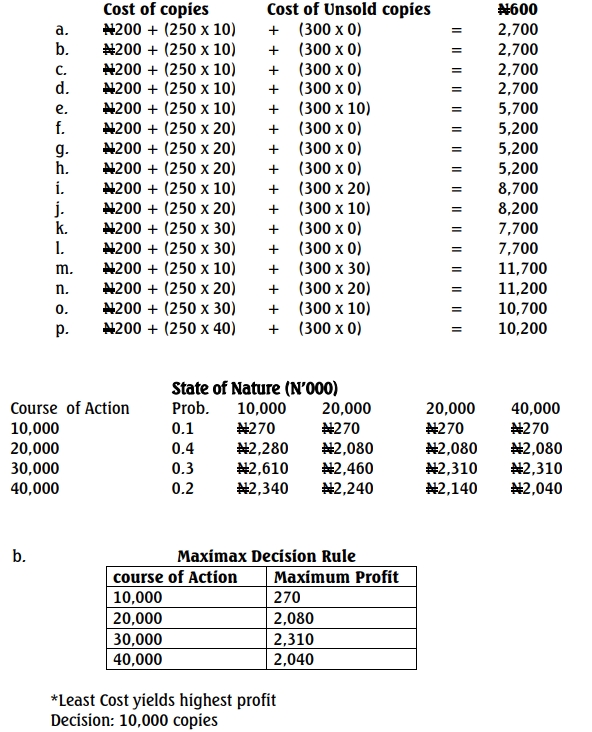
The local football club has asked for your advice on the number of programmes that should be printed for each game. The cost of printing and production of programmes for each game, as quoted by the local printer, is ₦1,000,000 plus ₦400 per copy. Advertising revenue which has been agreed for the season represents ₦800,000 for each game.

Programmes are sold for ₦150 each. A review of sales during the previous seasons indicates that the following pattern is expected to be repeated during the coming season of 50 games:

Number of programmes sold Number of games
10,000 5
20,000 20
30,000 15
40,000 10

Programmes not sold at the game are sold as waste paper to a paper manufacturer at ₦100 per copy.

Assuming that the four quantities listed are the only possibilities, you are required to:

a. Prepare a payoff table. (6 Marks)

b. Determine the number of programmes that would provide the highest profit if a constant number of programmes were to be printed for each game. (4 Marks)

c. Explain why you should buy 30,000 or 40,000 copies, assuming one of these is the most profitable quantity, despite the fact that the most probable sales are 20,000 copies per game. (2 Marks)

d. Calculate the profit which would arise from a perfect forecast of the numbers of programmes which would be sold at each game. (4 Marks)

e. Discuss the major limitations of the expected value criterion in decision making. (4 Marks)

c. Reason for buying 30,000 or 40,000 copies:

Even though the most probable sales are 20,000 copies per game, buying 30,000 or 40,000 copies allows the football club to maximize its profit in scenarios where sales exceed 20,000, and the losses from unsold copies can be minimized by selling them as waste paper at ₦100 per copy.


d. Profit from a perfect forecast:

With a perfect forecast, the club would always print exactly the number of programmes that would sell. Hence, it would always achieve the maximum profit for each game. The overall profit would be the highest possible given perfect knowledge of demand.


e. Limitations of the expected value criterion:

  • Assumes Repeated Events: Expected value assumes that the decision will be made many times, so over the long run, results will average out. However, in one-off decisions like printing programs for a single season, this may not hold.
  • Ignores Risk and Uncertainty: Expected value does not account for the variability or risk involved. Decision-makers may prefer more conservative approaches rather than relying purely on expected profit.
online
Knowsia AI Assistant

Conversations

Knowsia AI Assistant