- 20 Marks
Question
A national boutique chain sells a wide range of high-quality customized fashion goods. One particular outfit is bought at ₦8,000 and sold at ₦13,000. Mean holding costs per season per outfit are ₦500, and it costs ₦80,000 to order and receive goods in stock. The manufacturers require orders in advance, and once a batch is made, it is impossible to place a repeat order. Additionally, delivery cannot be staggered over the fashion season.
When a customer buys an outfit that requires adjustments, alterations are made, and the customer collects it later. Generally, if an outfit is out of stock at one boutique, it can be obtained from another branch within hours. However, if the chain as a whole runs out of stock, it loses both the outfit’s profit and an estimated ₦2,000 profit from additional items customers typically buy. If excess stock remains at season’s end, it is disposed of at ₦5,000 per outfit.
The sales pattern for a comparable outfit indicates the following probability distribution for total chain sales:
| Outfits Sold | Probability |
|---|---|
| 1,100 | 0.30 |
| 1,200 | 0.40 |
| 1,300 | 0.20 |
| 1,400 | 0.10 |
The management accountant must determine the optimal order quantity for the upcoming season to maximize expected profit, factoring in overstocking and understocking costs.
Required:
a) Determine the number of outfits to order to maximize expected profits.
(17 Marks)
b) Compare and contrast the model developed with the classical Economic Order Quantity (EOQ) model.
(3 Marks)
Answer
a)

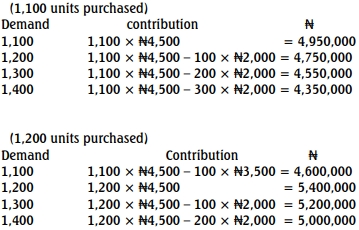
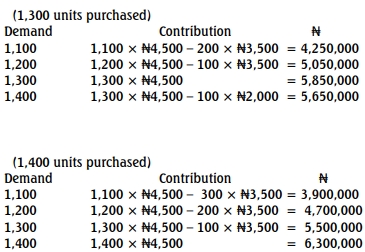
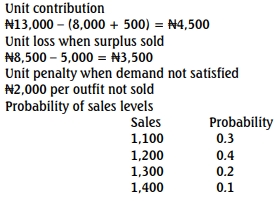
Contribution calculations


Summary of outcomes
Probability Order quantity
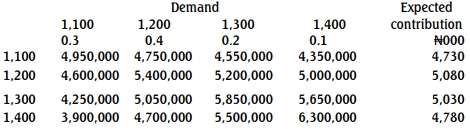
Application of probability on the Payoff Matrix
State of Nature (Sales)
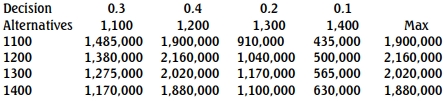
On the basis of the expected contribution the number of outfits to order is 1,200 units.
Note: The order/receipt costs of ₦80,000 are constant throughout and therefore have been ignored.
b) Comparison with EOQ Model:
- EOQ Assumptions vs. Actual Model: The classical EOQ model assumes continuous replenishment and known demand, whereas this scenario involves a single-order batch with probabilistic demand.
- Profit Maximization Focus: Unlike EOQ’s cost minimization, this approach centers on maximizing expected profit by balancing ordering costs against potential lost sales and excess inventory.
- Topic: Decision-making techniques
- Series: MAY 2021
- Uploader: Kwame Aikins