
Question
Answer
a) Balanced Scorecard Approach: The Balanced Scorecard (BSC) is a strategic performance management framework that incorporates financial and non-financial metrics to provide a comprehensive view of an organization’s performance. The BSC evaluates performance from four perspectives:
- Financial Perspective: Focuses on financial outcomes like profitability, return on investment, and economic value.
- Customer Perspective: Measures customer satisfaction, market share, and customer retention to ensure customer needs are being met.
- Internal Process Perspective: Focuses on internal operational processes that drive customer satisfaction and financial outcomes, aiming to improve efficiency and quality.
- Learning and Growth Perspective: Emphasizes employee skills, knowledge, and development, fostering innovation and organizational growth.
The BSC helps in aligning organizational activities to the vision and strategy, providing a balanced view of performance that encompasses both long-term and short-term objectives.
b) Return on Investment and Residual Income:
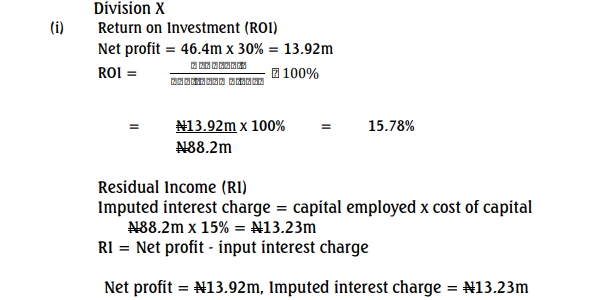
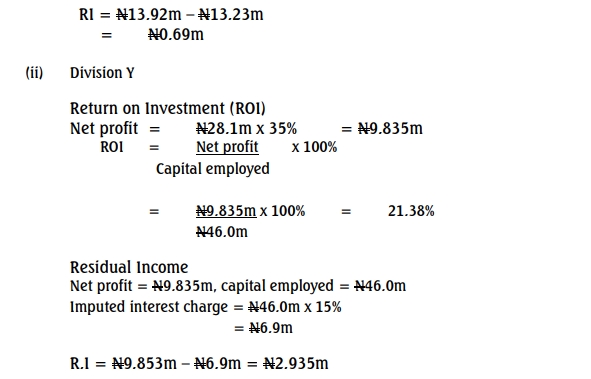
Comment:
- Return on Investment (ROI): Division Y has a higher ROI of 21.39% compared to Division X’s 15.78%. The ROI for Division Y exceeds the target ROI of 18%, making it a more favorable investment option.
- Residual Income (RI): Division X has a lower RI (₦0.69 million) compared to Division Y (₦2.935 million). Since RI considers the cost of capital, it provides a better indication of the value added by each division. In this case, both divisions generate positive RIs, indicating value addition, but Division Y performs better.
- The manager’s view of using RI aligns better with goal congruence, as RI encourages managers to invest only if it adds value above the cost of capital, preventing suboptimal decisions that might appear profitable under ROI but do not add value to the company as a whole.