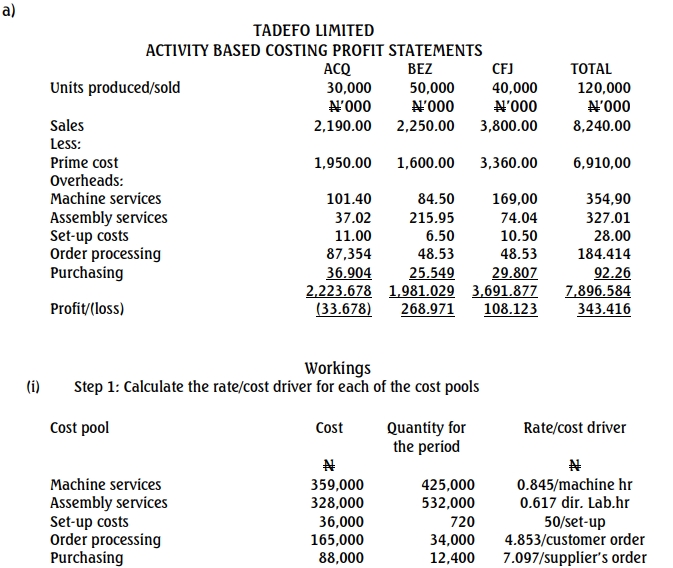
TADEFO LIMITED is a manufacturing company which produces and assembles car components. The company has two main production departments: Machining and Assembling. Each of the two departmental managers is responsible for producing annual budgets based on targets set by the management. From last year’s budget, TADEFO Limited hoped to turn an expected 10 percent rise in total revenue into a 20 percent increase in the company’s profits.

The following budgeted information relates to TADEFO Limited for the forthcoming period:

Products Information:

Products ACQ BEZ CFJ
Sales and production (units) 30,000 50,000 40,000
Selling price (per unit) (N) 73 45 95
Prime cost (per unit) (N) 65 32 84
Machine Dept. (hrs per unit) 4 2 5
Assembly Dept. (hrs per unit) 2 7 3

Overheads Re-Analyzed into Cost Pools:

Cost Pool Amount (N’000) Cost Driver Quantity for the period
Machine services 359 Machine hours 425,000
Assembly services 328 Direct labour hours 532,000
Set-up costs 36 Set-ups 720
Order processing 165 Customer orders 34,000
Purchasing 88 Supplier’s orders 12,400
Total Overheads 976

You have also been provided with the following estimates for the period:

ACQ BEZ CFJ
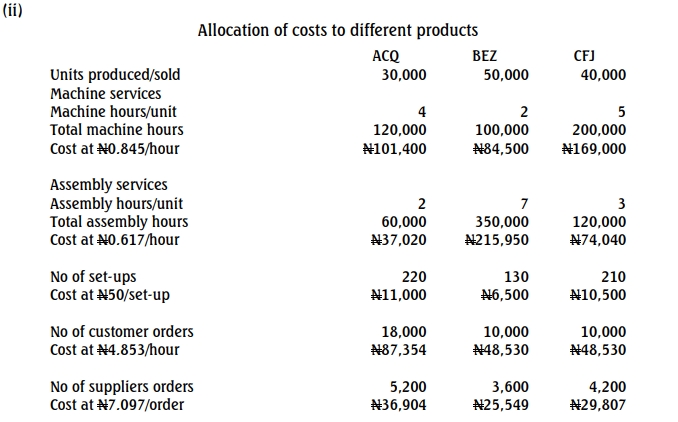
Number of set-ups 220 130 210
Customer orders 18,000 10,000 10,000
Suppliers’ orders 5,200 3,600 4,200

Required: a. Prepare and present a profit statement using activity-based costing. (14 Marks)
b. What would you consider to be the weaknesses of an incremental budgeting system for a company such as TADEFO Limited? (5 Marks)
c. Describe Activity-Based Budgeting (ABB) and comment on the advantages of its use by TADEFO Limited. (5 Marks)
d. Explain how the use of Zero-Based Budgeting (ZBB) can motivate employees. (3 Marks)
e. “Encouraging employee participation in budget setting is beneficial” Discuss. (3 Marks)

b. Weaknesses of Incremental Budgeting

Incremental budgeting is based on the current year’s results with an additional amount for growth or inflation in the next year. It is administratively simple but inefficient, as it can promote slack and waste. In Tadefo Limited’s competitive environment, this approach may not drive sufficient cost reduction and efficiency improvements. Incremental budgeting does not encourage exploring alternative options or performance enhancement.

c. Activity-Based Budgeting (ABB) Advantages

ABB uses activity-based costing data to establish budgets, emphasizing resource allocation based on activities. This approach ensures that Tadefo Limited can effectively allocate resources to value-adding activities, making budgeting more accurate and performance-oriented by controlling cost drivers rather than costs alone.

d. Zero-Based Budgeting (ZBB) and Employee Motivation

ZBB motivates employees by setting future-oriented objectives rather than relying on historical data. This budgeting process requires employees to justify activities from scratch, aligning them with organizational goals. ZBB can also increase job satisfaction and motivation by eliminating slack, fostering accountability, and aligning employee objectives with organizational goals.

e. Benefits of Employee Participation in Budget Setting

Involving employees in budget setting enhances morale, motivation, and commitment. Employees who contribute to budgets are more likely to commit to achieving targets, as they are realistic and aligned with operational needs. Furthermore, coordination between units is improved, and managers develop a sense of ownership, enhancing overall productivity.