- 15 Marks
Question
a. IAS 38 – Intangible Assets allows a business to choose one of two measurement models as its accounting policy for intangible assets after acquisition. However, the same model should be applied to all assets in the same class.
Required:
Discuss the TWO measurement models for intangible assets. (3 Marks)
b. Olumo-Taxi Limited’s financial year ends on December 31. The company adopted the revaluation model for its intangible assets and revalues them on a regular three-year cycle.
However, for intangible assets with a finite life, Olumo-Taxi Limited transfers the relevant amount from revaluation reserve to retained earnings each year.
During the year 2019, Olumo-Taxi Limited incurred N700,000 on the process of preparing an application for licenses for 15 taxis to operate in a holiday resort very close to Abeokuta. In order to prevent congestion and excessive traffic pollution, the licensing authority only allowed a small number of taxis to operate.
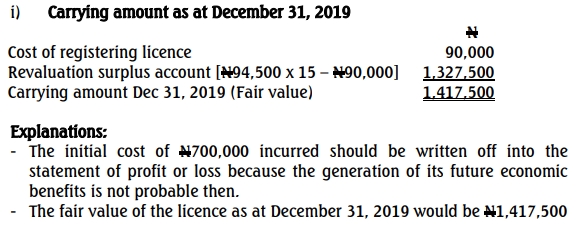
The outcome of the company’s application was uncertain up to November 30, 2019, when the local government authority accepted its application. In December 2019, Olumo-Taxi Limited incurred a cost of N90,000 in registering its licenses. The licenses were for a period of 9 years from January 1, 2019.
The licenses are freely transferable, and an active market in them exists. The fair value at December 31, 2019, was N94,500 per taxi, and Olumo-Taxi Limited carried them at fair value in its statement of financial position at December 31, 2019.
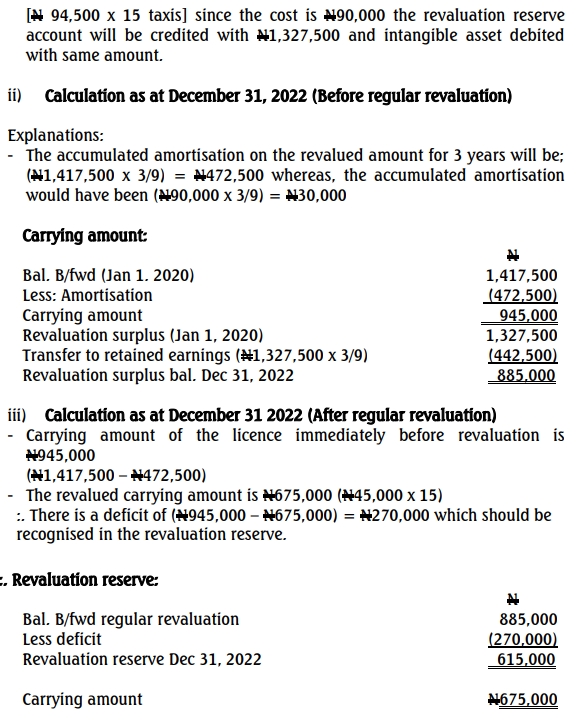
At December 31, 2022, Olumo-Taxi Limited undertook its regular revaluation. On that date, the licensing authority announced that it would triple the number of licenses offered to taxi operators, and there were transactions in the active market for licenses with six years to run at N45,000.
Required:
Calculate, with explanations, the carrying amount and revaluation surplus of the intangible assets of Olumo-Taxi Limited according to IAS 38 as at:
i. December 31, 2019
ii. December 31, 2022 (before regular revaluation)
iii. December 31, 2022 (after regular revaluation)
(12 Marks)
Answer
a:
Discussion of two measurement models for intangible assets:
- Cost Model:
Under the cost model, an intangible asset is carried at its cost less any accumulated amortization and impairment losses. This model is commonly used when there is no active market for the intangible asset to reference for fair value. Amortization is charged over the asset’s useful life unless the asset has an indefinite life, in which case it is tested for impairment annually. - Revaluation Model:
In the revaluation model, an intangible asset is carried at a revalued amount, being its fair value at the date of revaluation less any subsequent accumulated amortization and impairment losses. This model can only be applied if there is an active market for the intangible asset. Revaluations are done regularly to ensure the carrying amount does not differ significantly from fair value.
b:
Calculation and explanation of the carrying amount and revaluation surplus of Olumo-Taxi Limited’s intangible assets
- Tags: Amortization, IAS 38, Intangible Assets, Measurement Models, Revaluation
- Level: Level 2
- Topic: Impairment of Assets (IAS 36)
- Series: MAY 2024
- Uploader: Theophilus