
Question
Answer
i. In accordance with IAS 8, Accounting policies, changes in accounting
estimate and correction of prior period errors, a change in accounting
estimate involves a change in the periodic consumption of assets which is
similar to the case of Oluwaseun Plc. In line with IAS 8, a change in
accounting estimate should be applied prospectively i.e from the year of
change and in future periods. In addition, IAS 16 – Property, Plant and
Equipment states that when an entity changes its depreciation method and
useful live such should be treated as a change in accounting estimate and
the current and future years depreciation should be based on the carrying
amount of the asset at the date of the change.
Drawing from the above, the assistant accountants’ suggestion of crediting
the income statement with an amount debited from accumulated
depreciation is not acceptable and not in line with IAS 8 and 16.
By applying IASs 8 and 16, the carrying amount in the date of the change i.e 1st
October 2014 is derived as follows:
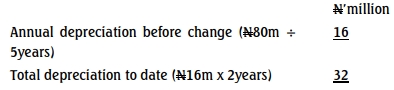
Therefore carrying amount at 1/10/2014 = N80m – N32m = N48m
So, for the year ended 30 September 2015, the depreciation charge will be
N48m divided by 6 (i.e the revised useful life of 8 less the already used up
life of 2 years). This depreciation charge should be a charge against profit or
loss for the current period and in future periods until a more reliable useful
life is determined.
In conclusion, the effect of this on the financial statements is to reduce the
annual depreciation charge from N16million to N8million. At the end of the
year the carrying amount of the asset would be (N48m – N8m) N40million.
All other things being equal a higher profit would be reported in the current year but would be much lower than it would have been if the assistant
accountant’s suggestion was followed.