Question
Answer
a. Risk Identification:
Risk identification is the first stage in risk management and involves recognizing potential risks that could affect the organization. This step involves setting up a risk committee or conducting brainstorming sessions with key stakeholders to identify operational, business, and strategic risks that could arise from both internal and external factors. Risks could include financial uncertainties, operational failures, legal liabilities, and technological disruptions.
b. Impact of Risk on Stakeholders:
Risk impacts various stakeholders in different ways:
- Employees: Risk may lead to job losses, reduced wages, or unsafe working conditions.
- Investors: They may face a loss of investments or reduced returns due to poor risk management, fluctuating stock prices, or even company insolvency.
- Creditors: A company’s inability to pay its debts could result in unpaid loans, leading to a high credit risk and affecting creditors’ profitability.
- Government: A failing business could reduce tax revenues, increase unemployment, and potentially lead to political instability.
c. Assessing Risks: Impact and Probability:
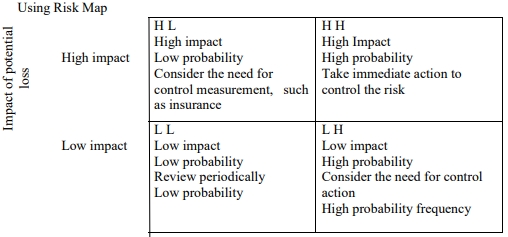
Assessing risk involves understanding both the impact and probability of each risk. This can be done using a Risk Map, which is a 2×2 matrix:
i)
Probability or frequency of the risk materialising
ii) Using Prose: It is a 2 x 2 matrix with four quadrants
- High Impact, Low Probability (HL): Consider control measures such as insurance.
- High Impact, High Probability (HH): Immediate action is needed to mitigate the risk.
- Low Impact, Low Probability (LL): Monitor periodically.
- Low Impact, High Probability (LH): Take control actions where necessary.
d. Measuring Risks:
Measuring risk involves quantifying the potential loss and determining risk tolerance. This process can include:
- Financial measurement: Measuring potential profit/loss or impact on revenue.
- Non-financial measurement: This could include potential injuries, customer dissatisfaction, or reputational damage. Risk measurement enables the company to set thresholds for acceptable risk levels and ensures that performance is measured against these thresholds.
e. Prioritizing Risks:
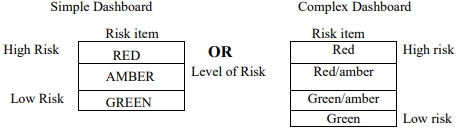
Risk prioritization involves determining which risks need to be addressed first based on their potential impact and likelihood. A Risk Dashboard can be used to categorize risks into high (red), medium (amber), and low (green) priority, helping management focus on mitigating the most critical risks while ensuring the company’s risk appetite is aligned with residual risks.
Use of Risk Dashboard