

(a) The following information is extracted from the financial statements of Kubua Plc for the year ended 30 September 2014:

Item Amount (N’000)
Ordinary Share Capital (fully paid at 1.25 kobo each) 20,000
Operating Profit before Tax 4,000

Other relevant information:

  1. The company’s income tax rate is 30%.
  2. The average fair value of one ordinary share during the year was N5.00.
  3. During the year, the company issued share options for 2.5 million ordinary shares to existing shareholders at an exercise price of N4.00.

Required:
Calculate the basic and diluted Earnings Per Share for the year ended 30 September 2014. Show all workings. (5 Marks)

(b) Extract from the Statements of Profit or Loss and Other Comprehensive Income of Bajulaye Plc. for the years ended:

Date 30/09/2014 (N’000) 30/09/2013 (N’000)
Revenue 5,000 2,800
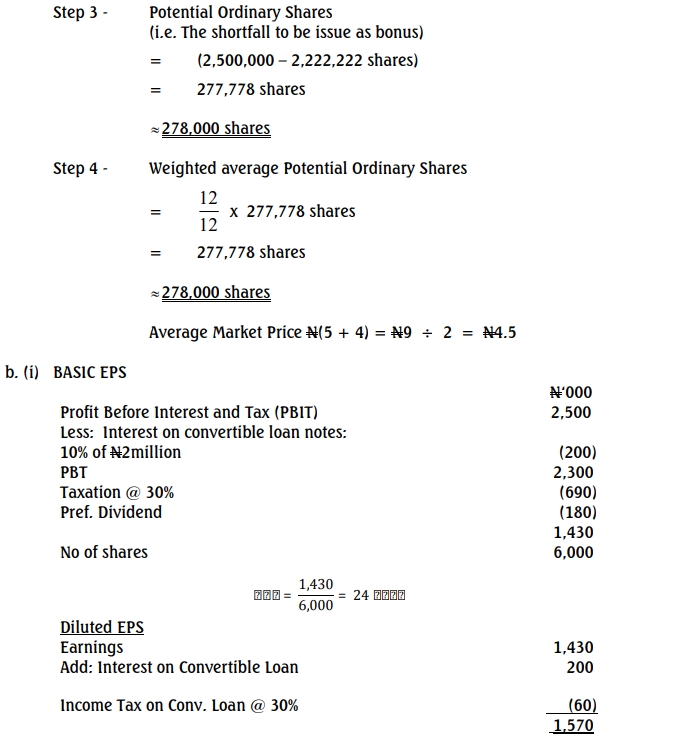
Profit Before Interest and Taxes (PBIT) 2,500 1,200

Extract from the Statements of Financial Position as at:

Date 30/9/2014 (N’000) 30/9/2013 (N’000)
Issued Share Capital (Ordinary Shares at 50k each) 3,000 3,000
12% Redeemable Preference Shares 1,500 1,500
Total Equity 4,500 4,500

Other relevant information:

  • On 1 January 2013, the entity issued convertible loan notes of N2,000,000 with an effective interest rate of 10% per annum.
  • The loan notes are convertible at nominal values of N100 each into the following number of ordinary shares:
    • 30 September 2018: 130 shares
    • 30 September 2019: 125 shares
    • 30 September 2020: 114 shares
    • 30 September 2021: 105 shares
  • Company income tax rate is 30%.

Required:

  1. Calculate the basic and diluted Earnings Per Share for the year ended 30 September 2014. (8 Marks)
  2. Write a short memo to the Board of Directors of Bajulaye Plc explaining FOUR advantages and THREE limitations of Earnings Per Share as a performance indicator to users of financial statements. (7 Marks)

(b) Memo to the Board of Directors: Advantages and Limitations of EPS

To: The Board of Directors, Bajulaye Plc
From: Financial Reporting Department
Subject: Advantages and Limitations of Earnings Per Share (EPS) as a Performance Indicator

Date: [Today’s Date]

Dear Board Members,

This memo addresses the benefits and limitations of Earnings Per Share (EPS) as a metric for evaluating company performance.

Advantages of EPS

  1. Widely Recognized Metric: EPS is a commonly understood performance measure, making it a straightforward metric for shareholders and potential investors to gauge profitability per share.
  2. Facilitates Comparability: EPS provides a standardized metric across different companies, enabling easier comparison of earnings on a per-share basis.
  3. Reflects Profit Distribution: EPS highlights the earnings attributable to each share, which is useful for assessing the return generated for each shareholder.
  4. Supports Investment Decisions: Since EPS is widely available, it assists in decisions regarding stock valuation and investment opportunities.

Limitations of EPS

  1. Susceptibility to Manipulation: EPS can be affected by accounting choices such as share buybacks or issuance, which may not reflect genuine business performance.
  2. Limited Insight on Overall Health: Focusing solely on EPS may overlook important aspects such as cash flow, liquidity, and debt levels, which also affect company stability.
  3. Ignores External Factors: EPS does not consider market conditions, industry trends, or non-operational factors, potentially giving an incomplete picture of profitability.

EPS is useful as an initial profitability indicator; however, it should be used alongside other metrics to form a comprehensive view of the company’s performance.

Sincerely,
[Your Name]
Financial Reporting Department