- 20 Marks
Question
Hurricane Limited
You are the audit manager in charge of the audit of Hurricane Limited. The company’s year-end is 31 December, and Hurricane Limited has been a client for seven years. The company purchases and resells fittings for ships, including anchors, compasses, rudders, sails, etc. Clients vary in size from small businesses making yachts to large companies maintaining large luxury cruise ships. No manufacturing takes place in Hurricane Limited.
Information on the company’s financial performance is available as follows:
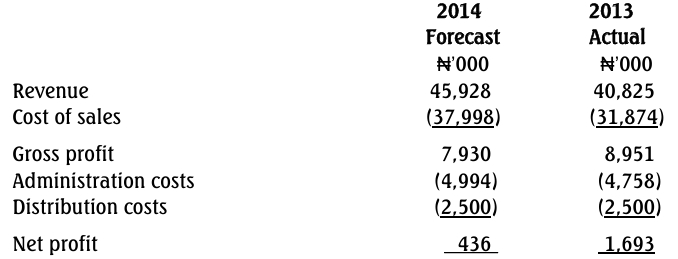
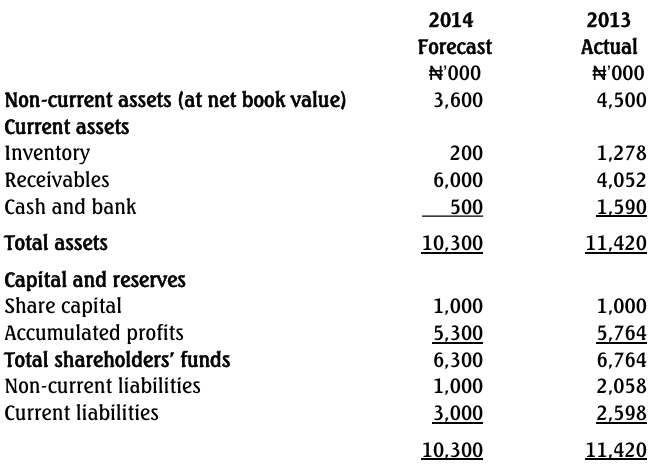
Other Information:
i. The industry in which Hurricane Limited operates has seen moderate growth of 7% over the last year.
ii. Non-current assets mainly relate to company premises for storing inventory. Ten delivery vehicles are owned with a net book value of ₦300,000.
iii. One of the directors purchased a yacht during the year.
iv. Inventory is stored in ten different locations across the country, with your firm again having offices close to seven of those locations.
v. A computerized inventory control system was introduced in August 2013.
vi. Inventory balances are now obtainable directly from the computer system. The client does not intend to count inventory at the year-end but relies instead on the computerized inventory control system.
Required:
a. ISA 300 Planning an Audit of Financial Statements, states that an auditor must plan the audit.
Explain why it is important to plan an audit. (5 Marks)
b. Using the information provided above, prepare the audit strategy for Hurricane Limited for the year ending 31 December 2014. (15 Marks)
Answer
a. Importance of Audit Planning (5 Marks)
ISA 300 Planning an Audit of Financial Statements highlights the importance of planning in enabling an effective and efficient audit. The main reasons for planning include:
- Efficient and Effective Audit Execution – Planning ensures that the auditor can execute the audit in a structured manner, covering all critical areas within the allocated time.
- Focus on High-Risk Areas – Identifying high-risk areas early in the planning process allows the auditor to allocate more time and resources to these areas, thereby enhancing the quality of the audit.
- Resource Allocation – Planning allows the auditor to identify the necessary personnel, skills, and resources required to complete the audit effectively.
- Client Coordination – Planning enables the auditor to align the audit activities with the client’s schedule, facilitating timely access to documents and information.
- Basis for Audit Program – Planning provides a foundation for developing an audit program that outlines the nature, timing, and extent of audit procedures.
b. Audit Strategy for Hurricane Limited (15 Marks)
Based on the information provided for Hurricane Limited, the audit strategy for the year ending 31 December 2014 should address key elements:
- Understanding Client Business and Industry
- Industry Growth: The industry has seen moderate growth, impacting revenue expectations and risk assessment.
- Nature of Operations: Hurricane Limited is a reseller of ship fittings with no manufacturing, reducing complexities in production but requiring careful scrutiny of inventory control and valuation.
- Materiality
- Set materiality levels based on revenue and net assets to guide the scope of substantive testing and judgment on financial misstatements.
- Audit Risks and Risk Assessment
- Inventory Control System: With a new computerized inventory control system introduced recently and reliance on system-reported balances, there is a risk of errors or manipulation in inventory figures.
- Non-current Assets: High-value assets like delivery vehicles and premises require depreciation assessments and checks for impairment.
- Receivables and Cash Management: Increased receivables raise concerns on cash flow management and credit control effectiveness.
- Audit Approach
- Systems Testing: Review the computerized inventory control system introduced in August 2013. Confirm that it is functioning correctly and that system-generated inventory balances are accurate.
- Inventory Counts: As the client does not intend to conduct a year-end physical inventory count, the audit team should implement alternative procedures, such as observation of periodic stock counts at various storage locations.
- Substantive Procedures: Perform substantive procedures on high-risk areas, such as revenue recognition, receivables, and the valuation of inventory.
- Key Audit Dates and Timeline
- Establish dates for the interim and final audits, plan meetings with the audit committee, and ensure that management is available for discussions and reviews as needed.
- Allocation of Resources
- Given the complexity and spread of inventory locations, allocate staff with relevant experience in inventory audits, particularly in verifying computerized inventory records. Engage IT specialists if necessary for the assessment of the inventory control system.
- Coordination with Client
- Coordinate with Hurricane Limited’s management to ensure timely access to required documentation, especially regarding inventory and receivables records. Communication is essential for the observation of stock counts at remote locations.
By following these strategic elements, the audit team will be able to perform a comprehensive and well-structured audit for Hurricane Limited, addressing potential risks and ensuring compliance with ISA 300.
- Tags: Audit Planning, Audit strategy, Inventory Control, ISA 300, Risk Assessment
- Level: Level 2
- Topic: Planning an Audit
- Uploader: Kofi