Question
Answer
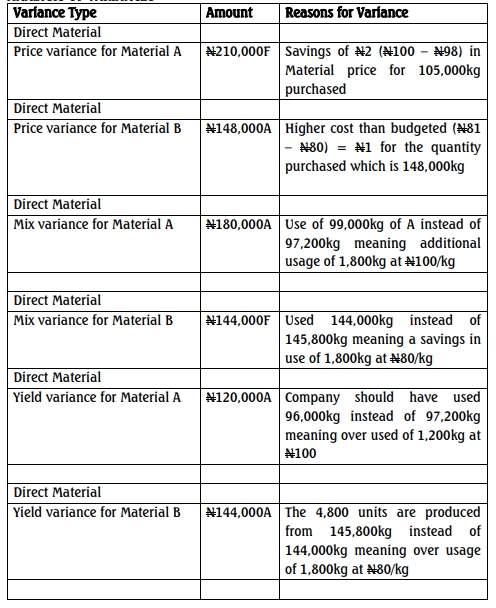
a) i) Material Price Variance
= AQP (SP – AP)
A 105,000(100 – 10,290,000/105,000) = ₦210,000 (F)
B 148,000(80 – 11,988,000/148,000) = ₦148,000 (A)
ii) Material Usage Variance:
= SP(SQ – AQ used)
A 100[(4,800 × 20kg) – 99,000] = ₦300,000 (A)
B 80[(4,800 × 30kg) – 144,000] = ₦0
iii) Material Mix Variance
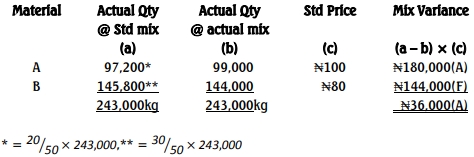
iv) Material Yield Variance
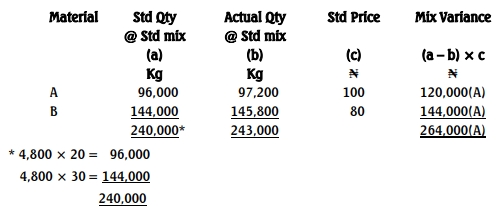
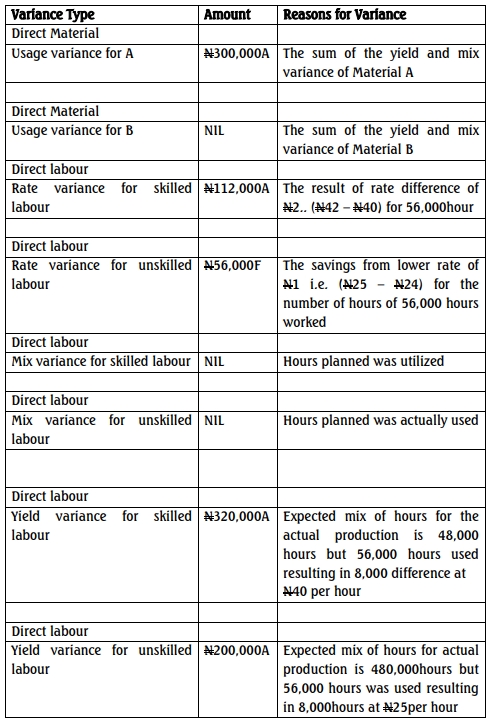
v) Labour Rate Variance = AH (SR – AR)
Skilled 56,000(₦40 – ₦2,352,000/56,000) = ₦112,000(A)
Unskilled 56,000(₦25 – ₦1,344,000/56,000) = ₦56,000(F)
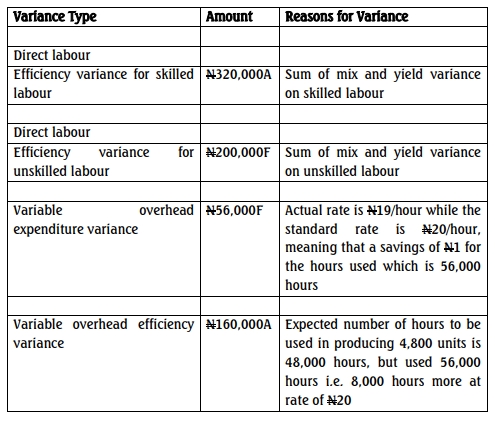
vi) Labour Efficiency Variance
= SR(SH – AH)
Skilled ₦40[(4,800 × 10hrs) – 56,000] = ₦320,000(A)
Unskilled ₦25[(4,800 × 10hrs) – 56,000] = ₦200,000(A)
vii) Labour Mix Variance
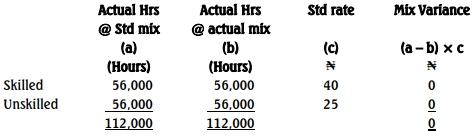
viii) Labour Yield Variance
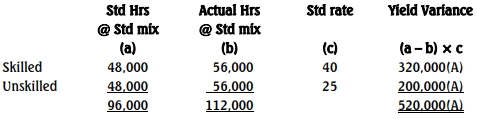
xi) Variable Overhead Expenditure Variance
= AH (SR – AR)
= 56,000(₦20 – ₦1,064,000/56,000) = ₦56,000(F)
x) Variable Overhead Efficiency Variance
= SR (SH – AH)
= ₦20[(4,800 × 10hrs) – 56,000] = ₦160,000(A)
(b) Possible Causes of the Variances:
- Material Price Variance:
- Material A (Favorable): Likely due to efficient negotiation or purchasing a lower-grade material.
- Material B (Adverse): Likely due to unexpected increases in market prices or inaccurate budget standards.
- Material Usage Variance:
- Material A (Adverse): Possibly caused by inferior material quality or inexperienced operatives leading to excess usage.
- Material B (Favorable): Effective material utilization or careful handling.
- Labour Rate Variance:
- Skilled Labour (Adverse): Likely due to employing higher-paid skilled workers or unexpected wage rate increases.
- Unskilled Labour (Favorable): Possibly due to hiring at lower wage rates or efficient negotiation.
- Labour Efficiency Variance:
- Skilled and Unskilled Labour (Adverse): Poor quality raw materials, high rework rates, machine issues, power outages, or inadequate supervision.
- Variable Overhead Variance:
- Expenditure (Favorable): Savings from efficient overhead cost control.
- Efficiency (Adverse): Overuse of hours possibly due to low efficiency in production operations.
Note: credit will be given for alternative relevant points
b) ANALYSIS OF VARIANCES