
Question
Pestel Limited produces cake and bread which it supplies to a major supermarket in
Abuja. It holds no inventories because it adopts the Just-In-Time (JIT) system.
The standard cost of the wheat used in baking the products is N200 per kg. Each piece
of cake uses 0.5kg of wheat while each loaf of bread uses 2kg of wheat.
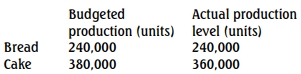
The production levels for cake and bread for the month of October were as follows:
The actual cost of wheat in October was N232 per kg. 496,000kg of wheat was used to
bake the bread and 190,000kg was used to bake the cake.
The global prices of wheat increased by 18% in the month of October.
At the beginning of the month, the supermarket group made an expected request for an
immediate shape change to the cake resulting in 5% more wheat than previously
required. This change also brought about production delays which caused a reduction in
production by 20,000 units of cake in that month. The production director is given the
task of purchasing relevant input materials and any production request which occur,
although he does not take responsibility for setting standard costs.
Required:
(a) Compute the following variances for the month of October for each product and in total:
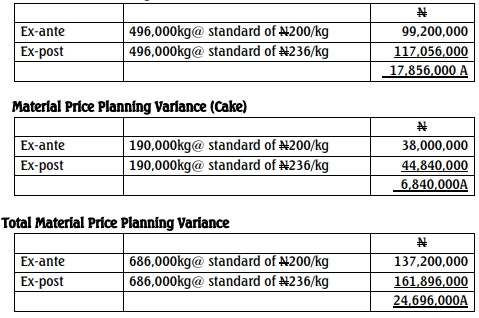
(i) Material price planning variances, (4 Marks)
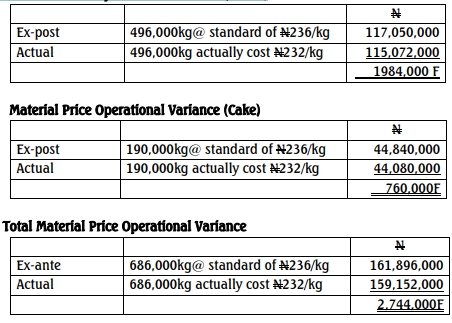
(ii) Material price operational variances. (4 Marks)
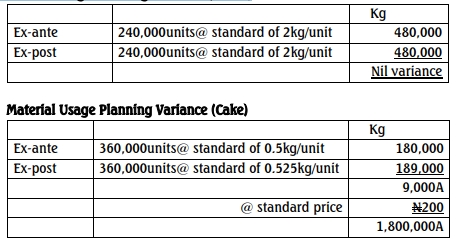
(iii) Material usage planning variances, (4 Marks)
(iv) Material usage operational variances (4 Marks)
(b) Discuss the benefits of planning and operational variances to a management accountant. (4 Marks)
Answer
PESTEL LIMITED
Computation of Ex-ante and Ex-post Standards
Ex-ante
Standard cost per cake:
0.5kg @ N200 per kg = N100
Standard cost per loaf of bread
2kg @ N200 per kg = N400
Ex-post
Standard cost per cake:
(1.05 x 0.5) 0.525kg @ (200 x 1.18) N236 per kg = N123.9
Standard cost per loaf of bread:
2kg @ (N200 x 1.18) N236 per kg = N472
a(i) Material Price Planning Variance (Bread)
a(ii) Material Price Operational Variance (Bread)
a(iii) Material Usage Planning Variance (Bread)
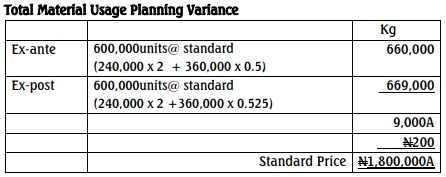
a(iv) Material Usage Operational Variance (Bread)
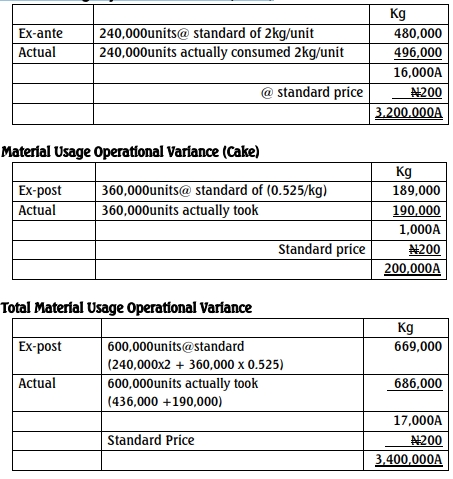
(b) Benefits of Planning and Operational Variances:
- Identify inefficiencies in resource planning and operational control.
- Facilitate budget updates based on realistic standards.
- Enhance managerial assessment with variance analysis for accurate performance review.
- Provide insights into operational efficiency under current market conditions.
- Motivate employees by establishing attainable performance targets.
- Improve the standard-setting process by incorporating operational realities.