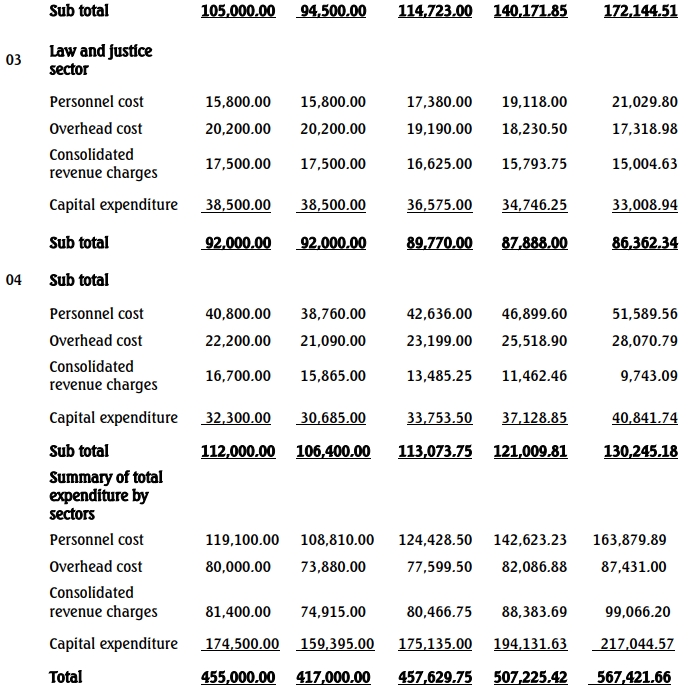
The ministry of finance of Ojaja Republic prepared the aggregate Medium-Term Expenditure-Framework (MTEF) budget for consideration by the National Assembly as contained in the country’s Constitution. The following are the MTEF actual budget estimates and the approved budget estimates by various sectors as thoroughly screened by the Budget Committees of the Senate and House of Representatives:

Ojaja Federal Republic Summary of total budgeted expenditure by sector for 2020

Sector Code Sector Name Actual Estimates 2020 (N’m) Approved Estimates 2020 (N’m)
01 Administrative Sector
Personnel Cost 40,000 34,000
Overhead Cost 25,000 21,250
Consolidated Revenue Charges 18,600 15,810
Capital Expenditure 62,400 53,040
Sub-Total 146,000 124,100
02 Economic Sector
Personnel Cost 22,500 20,250
Overhead Cost 12,600 11,340
Consolidated Revenue Charges 28,600 25,740
Capital Expenditure 41,300 37,170
Sub-Total 105,000 94,500
03 Law and Justice Sector
Personnel Cost 15,800 15,800
Overhead Cost 20,200 20,200
Consolidated Revenue Charges 17,500 17,500
Capital Expenditure 38,500 38,500
Sub-Total 92,000 92,000
04 Regional Sector
Personnel Cost 40,800 38,760
Overhead Cost 22,200 21,090
Consolidated Revenue Charges 16,700 15,865
Capital Expenditure 32,300 30,685
Sub-Total 112,000 106,400

Summary of total expenditure by sectors:

Description Actual Estimates 2020 (N’m) Approved Estimates 2020 (N’m)
Personnel Cost 119,100 108,810
Overhead Cost 80,000 73,880
Consolidated Revenue Charges 81,400 74,915
Capital Expenditure 174,500 159,395
Total 455,000 417,000

Additional Information:
(i) Administrative sector – all costs at an incremental basis of 15%, except for capital expenditure which will increase by 10%.
(ii) Economic sector – all costs at an incremental basis of 25%, except for overhead cost which will decrease by 5%.
(iii) Law and justice sector – all costs at a declining basis of 5%, except for personnel cost which will increase by 10%.
(iv) Regional sector – all costs at an incremental basis of 10%, except for consolidated revenue charges which will decrease by 15%.

Required:
a. Prepare proposed budget estimates for 2021, 2022, and 2023 based on the approved estimates for the year 2020. (20 Marks)
b. Explain the following in relation to National Chart of Accounts (NCOA) structure for budgeting:
i. Functional segment (2 Marks)
ii. Programme segment (2 Marks)
iii. Geographical segment (2 Marks)
c. Enumerate FOUR steps required for budgeting with the National Chart of Accounts. (4 Marks)

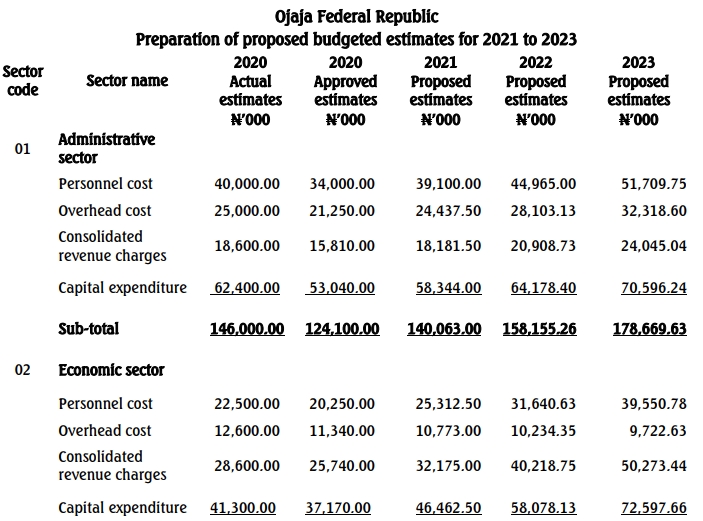
a. Proposed Budget Estimates (2021-2023)
b. National Chart of Accounts (NCOA) Structure
i. Functional Segment: The functional segment classifies the expenditure and revenue according to the functions of government, for example, administrative, economic, social, and environmental functions.
ii. Programme Segment: This segment provides a detailed breakdown of government programmes and sub-programmes within each function. It facilitates the tracking of specific programme performance within the national budget.
iii. Geographical Segment: This segment identifies the location (geographical areas) where expenditures and revenues are generated or allocated. This helps in understanding the impact of government activities across different regions.

c. Steps Required for Budgeting with the National Chart of Accounts

  1. Identifying the relevant segments (functional, programme, geographical) in line with the national budget priorities.
  2. Assigning expenditures and revenues to the respective segments based on budget guidelines.
  3. Compiling the segment-wise data into the government’s overall financial reporting framework.
  4. Verifying and reconciling the segment data to ensure accuracy and completeness in the budget presentation.