QUESTION 5
Dat Air was founded in January 2010 by Dr. Daniel Taiwo and the airline has been
branded as a low-cost airline in Nigeria. Dat Air‟s strategy is to operate as a low-cost and highly efficient airline, and it does this by:
(i) Operating mostly in cities where other airlines do not fly to reduce landing
cost;
(ii) Using only one aircraft model in order to reduce maintenance and operational
costs. These planes are leased rather than bought outright;
(iii) Having only one category of seat class; there is no pre-allocated seats or in-
flight entertainment; and to
(iv) Focus on e-commerce with customers both booking tickets and checking in
for flights online. Customers who booked well in advance before the flight
date enjoy substantial discount.
The airline was given an „on time arrival‟ ranking of second best by the
Nigerian aviation authority, who rank all 20 airlines operating locally in the
country based on the number of flights which arrive on time at their
destinations. 48 Dat Air flights were cancelled in 2018 compared to 35 in
2017. This increase was due to an increase in the staff absentee rate at Dat
Air from 5 days per staff member per year to 7 days.
The average „ground turnaround time‟ for airlines in Nigeria is 2 hours,
meaning that, on average, planes are on the ground for cleaning, refuelling,
etc for 2 hours before departing again. Customer satisfaction surveys have
shown that 90% of customers are happy with the standard of cleanliness on
Dat Air‟s planes.
The number of passengers carried by the airline has grown from 200,000
passengers on a total of 2,107 flights in 2010 to 650,000 passengers on
5,320 flights in 2018. The overall growth of the airline has been helped by
the limited route licensing policy of the Nigerian government, which has
given DAT Air almost monopoly status on some of its routes. However, the
government is now set to change this policy with almost immediate effect,
and it has become more important than ever to monitor performance
effectively.
This has necessitated the management of Dat Air to examine the airline‟s
performance using the balanced scorecard model. This will enable the
management to discover areas where improvement is needed in its
operations.
Required:
a. Describe each of the FOUR perspectives of the balanced scorecard.
(6 Marks)
b. For each perspective of the balanced scorecard, identify ONE goal
together with a corresponding performance measure which could be
used by DAT Air to measure the company‟s performance. The goals
and performance measures should be specifically relevant to Dat Air.
For each pair of goals and performance measures, explain why you
have chosen them. (9 Marks)
c. Appraise the usefulness of the balanced scorecard as a performance
evaluation technique. (5 Marks)
(Total 20 Marks)

a. Four Perspectives of the Balanced Scorecard:

  • Financial Perspective: Focuses on the financial performance of the company, such as profitability and cost management.
  • Customer Perspective: Looks at customer satisfaction and market share by examining how customers perceive the company.
  • Internal Business Processes: Concentrates on the efficiency and effectiveness of internal operations that lead to the company’s success.
  • Learning and Growth: Emphasizes the ability of the organization to innovate, improve, and learn, which supports future growth.

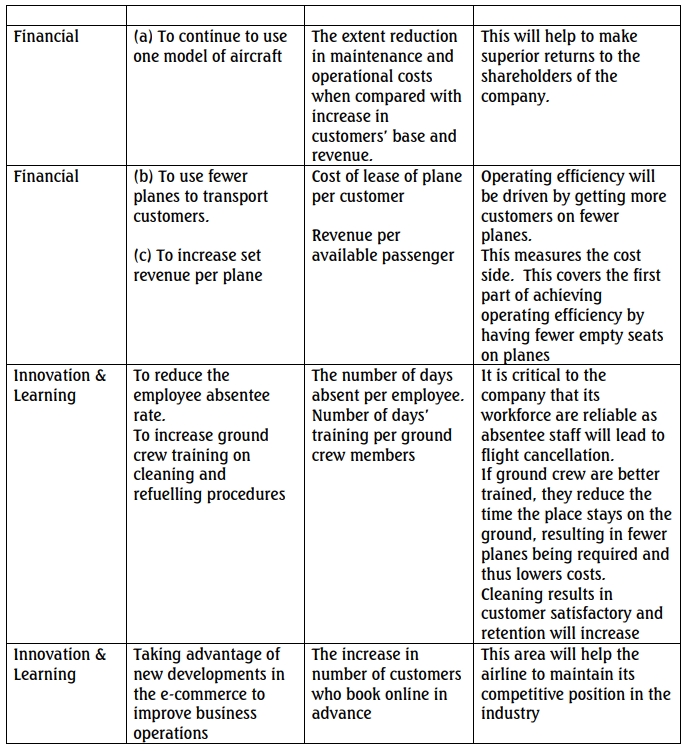
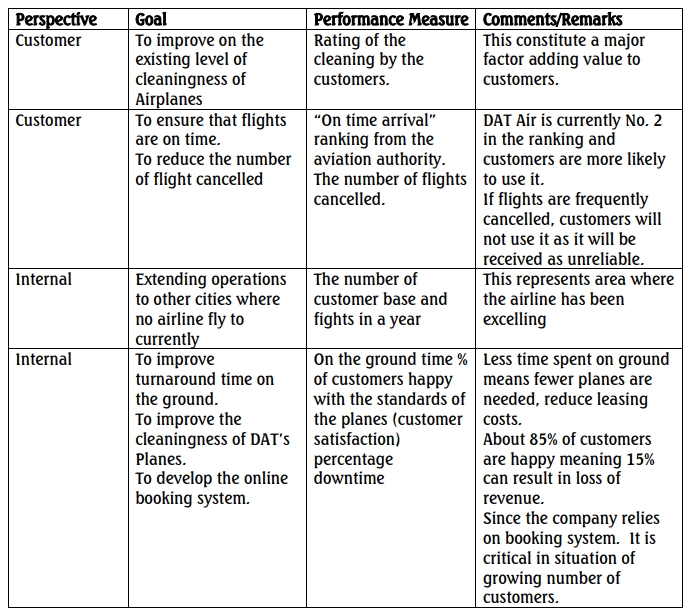
b. Goals and Performance Measures for DAT Air:
c. APPRAISAL OF THE USEFULNESS OF THE BALANCED SCORECARD AS A
PERFORMANCE EVALUATION TECHNIQUE

  •  Better Strategic Planning
    The Balanced Scorecard provides a powerful framework for building and
    communicating strategy. The business model is visualised in a Strategy
    Map which helps managers to think about cause-and-effect relationships
    between the different strategic objectives. The process of creating a
    Strategy Map ensures that consensus is reached over a set of interrelated
    strategic objectives. It means that performance outcomes as well as key
    enablers or drivers of future performance are identified to create a
    complete picture of the strategy.
  • Improved Strategy Communication & Execution
    Having a one-page picture of the strategy allows companies to easily
    communicate strategy internally and externally. We have known for a
    long time that a picture is worth a thousand words. This ‘plan on a page’
    facilitates the understanding of the strategy and helps to engage staff
    and external stakeholders in the delivery and review of the strategy. The
    thing to remember is that it is difficult for people to help execute a
    strategy which they don‟t fully understand.
  • Better Alignment of Projects and Initiatives
    The Balanced Scorecard helps organisations map their projects and
    initiatives to the different strategic objectives, which in turn ensures that
    the projects and initiatives are tightly focused on delivering the most
    strategic objectives.
  • Better Management Information
    The Balanced Scorecard approach helps organisations design key
    performance indicators for their various strategic objectives. This ensures
    that companies are measuring what actually matters. Research shows
    that companies with a BSC approach tend to report higher quality
    management information and better decision-making.
  • Better Process Alignment
    Well implemented Balanced Scorecards also help to align organisational
    processes such as budgeting, risk management and analytics with the
    strategic priorities. This will help to create a truly strategy focused
    organisation.
online
Knowsia AI Assistant

Conversations

Knowsia AI Assistant