Below is a workpaper prepared and reviewed by members of an audit engagement team.

Client: [Name not provided]
Subject: Trade Payables
Period End: [Not provided]

Objective: To ensure trade payables is fairly stated

Work performed: Selected a sample of 5 trade payables balances as at 31 March and reconciled the supplier statements to the year-end trade payables ledger. Reconciling items were vouched to source documentation.

Results
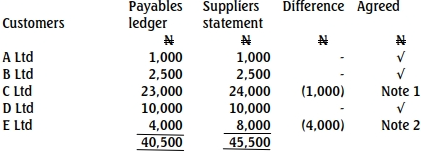
Required:
a. Review the above workpaper and comment on the missing items. (8 Marks)
b. An accounts personnel at the client office requested that you give him your audit working papers. Explain the ownership, custody, and confidentiality of audit working papers. (3 Marks)
c. Explain sampling and sampling risk. (3 Marks)
d. In order to reduce sampling risk appropriately, ISA 530 requires the auditor to make certain considerations in designing a sample. Explain these considerations. (2 Marks)
e. Explain the advantages and disadvantages of statistical sampling. (4 Marks)

a. Missing Items in Workpaper (8 Marks):

  1. The name of the client is not stated.
  2. The period covered by the review is missing.
  3. There is no reference to the files used to verify trade payables.
  4. The name of the person who prepared the workpaper is not stated.
  5. The date of preparation of the workpaper is not provided.
  6. The name of the person who reviewed the workpaper and the extent of the review are not mentioned.
  7. There are no notes or conclusions regarding the differences identified.
  8. There are no tick marks or explanations for the notes made in the reconciliation.

b. Ownership, Custody, and Confidentiality of Audit Working Papers (3 Marks):

  • Ownership: Audit working papers are the property of the auditor and do not belong to the client.
  • Custody: The auditor is responsible for maintaining the working papers in a secure environment to prevent unauthorized access.
  • Confidentiality: The auditor must keep working papers confidential and only disclose them to third parties if required by law or with the client’s consent.

c. Sampling and Sampling Risk (3 Marks):

  • Sampling: This is the process of selecting a subset of items from a population for audit testing to draw conclusions about the entire population.
  • Sampling Risk: This is the risk that the sample selected by the auditor may not be representative of the population, leading to incorrect conclusions about the population as a whole.

d. Considerations to Reduce Sampling Risk (ISA 530) (2 Marks):

  1. Sample Size: The auditor should select a sufficient sample size to reduce sampling risk.
  2. Selection Method: The auditor should use appropriate sampling techniques to ensure the sample is representative of the population.

e. Advantages and Disadvantages of Statistical Sampling (4 Marks):

  • Advantages:
    1. Provides a basis for making inferences about the entire population.
    2. Enables the auditor to quantify sampling risk.
    3. Reduces the chance of bias in sample selection.
  • Disadvantages:
    1. Can be complex and time-consuming to design and implement.
    2. Requires specialized knowledge to interpret statistical results.
    3. May not be appropriate for populations with small, non-random items.