TK is a company that produces toy television sets targeting children of the elite. The company has two divisions, Division S and Division B. Division S manufactures components for the televisions and sells components to Division B and to external customers. Division B uses five of the components in each of the toy television sets that it manufactures and sells television sets directly to external customers.

Division S
Budgeted variable manufacturing cost per component (N):

  • Direct material: 140
  • Direct labour: 180
  • Variable overhead: 120

Additional Information:

  • Fixed costs: N5,600,000
  • Production capacity: 175,000 components
  • External demand: 150,000 components
  • Potential demand from Division B: 80,000 components
  • Anticipated external market price for a component: N500

Division B

  • Sales price: N4,500
  • Budgeted variable manufacturing cost per television (N):
    • Direct material: 400
    • Direct labour: 620
    • Variable overhead: 160

Each toy television set produced needs five components. Fixed costs are budgeted to be N14,600,000 for next year. Annual sales of the toy television sets are expected to be 16,000 units.

Transfer Pricing Policy:

  • Transfer prices are set at opportunity cost.
  • Division S must satisfy the demand of Division B before selling components externally.
  • Division B is allowed to purchase components from Division S or from external suppliers.

Required:
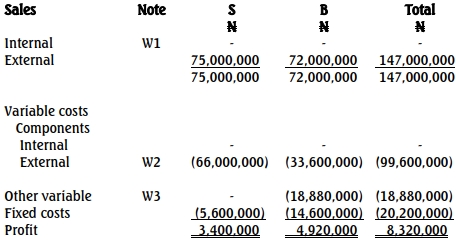
a. Assuming that Division B buys all the components it requires from Division S:
Prepare a profit statement for each division detailing sales and costs, showing external sales and internal company transfers separately where appropriate. (6 Marks)

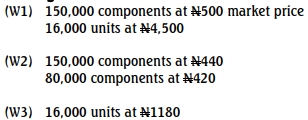
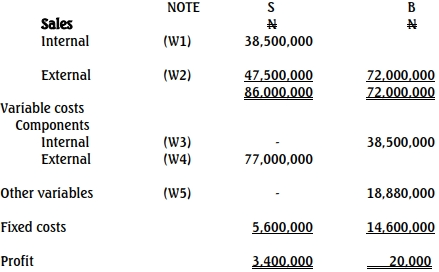
b. A specialist external supplier has approached Division B and offered to supply 80,000 components at a price of N420 each. The components fulfil the same function as those manufactured by Division S. The manager of Division B has accepted the offer and agreed to buy all the components it requires from this supplier:
i. Produce a revised profit statement for each division and for the total TK company.
ii. Division S has just received an enquiry from a new customer for the production of 25,000 components. The manager of Division S requires a total profit for the year for the division of N4,500,000.

  • Calculate the minimum price per component to sell the 25,000 components to the new customer that would enable the manager of Division S to meet the profit target. (4 Marks)

Note: This order will have no effect on the divisional fixed costs and no impact on the 150,000 components Division S sells to its existing external customers at N500 per component. Division B will continue to purchase the 80,000 components it requires from the specialist external supplier.

Workings

b

(i)

Workings

b

(ii)

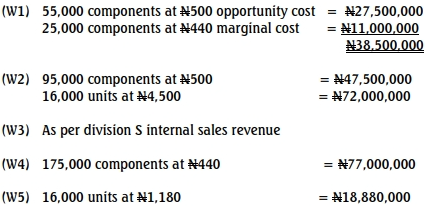
(b)(ii) Minimum Price Calculation for New Customer:

  • Profit Requirement: N4,500,000
  • Remaining production capacity N25,000 = N175,000 – N150,000
  • Current Profit: N3,400,000
  • Additional Profit Required: N1,100,000
  • Contribution per Component: N44 (N1,100,000 / 25,000 components)
  • Minimum Price per Component: N484 (N440 + N44)