
Question
DASET DRINKS NIGERIA PLC.
(30 MARKS)
Daset Drinks Nigeria Plc. has been operating in the Nigerian food and beverages
industry as an entity with three distinct factories across the country. One of the
factories bottles soft drink while the other two produce bottles and crown corks for
the soft drink factory.
The company has recently been experiencing problems with its performance
evaluation system across the three factories. Each factory manager is of the
opinion that his factory is the one contributing the most to the overall performance
of the company.
In a recent management retreat, the guest speaker, a performance management
expert, emphasised the need to develop Key Performance Indicators (KPI) for each
of the factories and departments in the company. According to him, this will
enhance performance evaluation of all the managers in the company and will also
make performance management easier. He suggested that the company should
adopt a divisional structure whereby each of the factories will become an
autonomous division with responsibilities for investment, revenues, profits and
costs.
At the last Executive Management meeting, after the retreat, the company‟s top
management decided to adopt the recommendations of the guest speaker. The top
management agreed transfer prices acceptable to each of the divisional managers
and also the needs to decide whether the two factories manufacturing bottles and
corks cocks could sell to external markets.
The top management has mandated you, as the company‟s management
accountant, to supply necessary data that will assist them in taking appropriate
decisions.
Financial data collected about the company‟s operations are as follows:
The costs and selling prices of the divisions are:
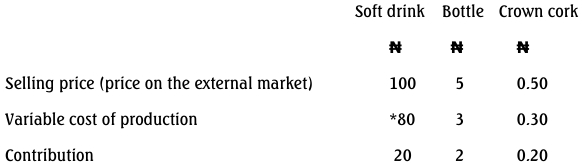
This includes costs of bottle and crown cork. To produce one bottle of soft drink
requires one bottle and one crown cork.
The bottling division has the choice to buy its bottle and crown cork requirements
from the external market.
The variable costs of production for external sales and internal transfers are the
same and bottles and crown corks are being transferred to the bottling division at
these costs.
For brand protection, the soft drink factory is not willing to buy bottles and crown
corks from any external supplier.
Required:
a. Differentiate among an investment centre, a profit centre, a revenue centre
and a cost centre, in a divisional organisation giving one example of each.
(8 Marks)
b. Explain a divisional structure, stating the problems associated with this type
of structure in an organisation. (8 Marks)
c. Advise the top management on the transfer prices that will maximise the
company‟s profit and be acceptable to the factory managers.
(10 Marks)
d. Discuss TWO qualitative factors that the top management needs to consider
in taking these decisions. (4 Marks)
Answer
(a)
DASET DRINKS NIGERIA LIMITED
Investment centre
An investment centre is a division within an organisation where the manager
is responsible not only for the costs of the division and the revenues, but also
for decisions relating to investment in assets for the division. An investment
centre manager usually has authority to purchase new assets, such as items
of plant or equipment, and so should be responsible for the profit or return
that the division makes on the amount that it has invested.
The performance of an investment centre might be measured by calculating
the profit as a percentage of the amount invested (The Return on
Investments (ROI)). It could also be measured by considering the residual
profit after making provision for cost of capital.
An investment centre might include a number of different profit centres. For
example, a company manufacturing cars and buses may have two
investment centres: (1) car-making and (2) bus-making. Within the bus
making division, there could be several profit centres, each of these being a
separate location or factory at which buses are manufactured and
assembled.
Profit centre
A profit centre is a department or division within the organisation for which
revenues as well as costs are established.
The profit or loss that the centre makes is determined by measuring the costs
of the products or services produced by the centre to the revenues earned
from selling them.
The following is an example of a summarised profit centre report:
Revenues of the profit centre
N
‟000
***
Costs of the units sold by the profit centre
Profit/(loss) of the profit centre
A profit centre may consist of several cost centres. For example, a factory
might be treated as a profit centre, and within the factory, the machining
department, assembly department and finishing department could be three
cost centres.
Revenue centre
A revenue centre is a department or division within the organisation for
which revenues are generated.
In a revenue centre, there is no
measurement of cost or profit. Revenue centre managers will only need to
have information relating to revenues and will be accountable for revenuesonly. For example, the income accountant in a hospital is only responsible
for recording and controlling the different incomes that are received from
funding bodies or other sources (for example, private patients, donors,
fundraising and so on).
Cost centre
A cost centre is a department or work group for which costs are established,
in order to measure the cost of output produced by the centre. For example,
in a factory, a group of machines might be a cost centre. The costs of
operating the machines would be established, and a cost could then be
calculated for each unit of product manufactured by the machines.
In a cost centre, there is no measurement of revenue or profit.
(b)
A divisionalised structure refers to the organization of an entity in which
each operating unit has its own management team which reports to a head
office.
Divisions are commonly set up to be responsible for specific
geographical areas or product lines within a large organization.
When an organization has a divisionalised structure, some of the divisions
may supply goods or services to the other divisions in the same organization.
The division that sells goods or services to other divisions is referred to as
selling division. While the division(s) that buy(s) the goods or services is
(are) referred to as buying division(s).
The problems likely to be associated with a divisionalised structure include:
The problem of acceptable transfer price between the selling and the
buying division. A decision has to be made about what the transfer
price should be for goods and services transferred from one division to
another;
Goal congruence – Each divisional manager may be pursuing goals
that are good for his/her division but not in the best interest of the
organization as a whole. For example, a divisional manager for a
division that is an investment centre, may put off buying a needed
non – current asset so as to improve his/her return on investment
(ROI);
Top management may lose control over the organization if they allow
decentralization without accountability.
It will be necessary to monitor divisional performance closely. The cost of such monitoring
system may be high;
Performance Measurement – How to evaluate the performance of the
Divisional Managers may pose some problems; and
There may be duplication of functions and functional managers. Each
division may have to set up its functional units with managers
overseeing the functions.
(c) Ideal transfer Price:
First, what is in the best interest of the company as a whole is determined.
For each bottle of soft drink that the company produced and sold, the
company makes additional contribution as follows:
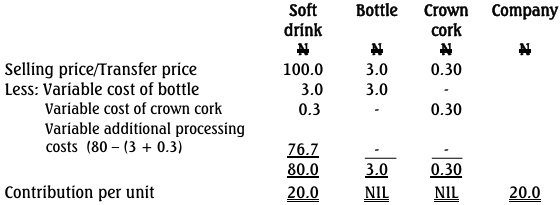
If bottling division buys bottles and crown corks internally, the company, as
a whole, will make N20.0/unit contribution even though it looks like bottle
and crown corks divisions did not contribute anything to the overall
contribution.
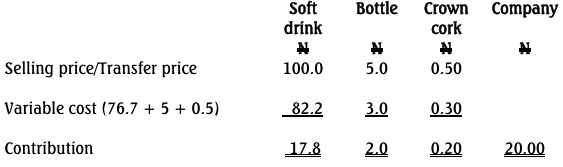
However, if the bottling division buys bottles and crown cork at external
market prices, the company, as a whole, also makes N20 contribution with
soft drinks bottle and crown cork divisions making contribution as follows:
Ideal Transfer Prices:
Since the external market price of bottles and crown corks are ₦5 and ₦0.5
respectively, and variable costs of production are ₦3 and ₦0.3 respectively,
the ideal transfer prices are as follows:
Bottles; from ₦3 to ₦5.
In view of the current arguments of the divisional managers, ₦5, which is
the external market price, will be the most ideal for evaluation of the
divisional manger‟s performance.
Crown corks; from ₦0.3 to ₦0.5.
In view of the current arguments of the divisional managers, ₦0.5, which
is the external market price, will be the most ideal for evaluation of the
divisional manger‟s performance.
(d)
Other qualitative factors the top management needs to consider in taking
these decisions include:
Will the external supplier be able to meet up with the quality that
meets with the bottling division‟s specifications?
To protect the company‟s brand, it is also very important to buy from
the internal supplier rather than the external supplier;
The company may not be able to control the external supplier as it can
do with the internal suppliers;
The external suppliers may not be able to meet up with the demand of
the bottling division for bottles and crown corks, as the case may be,
because they will have to satisfy their other customers as well;
Market conditions: Would the bottle and crown cork divisions be able
to produce and sell all their products in the external market?
The need to encourage initiatives of the divisional managers;
Loss of market shares if transfers are to be made internally using
variable costs; and
The level of exposure and experience of the divisional managers.