
Question
Answer
Porter’s Diamond model provides an analysis of the factors that give a country or a region a comparative competitive advantage, which ultimately inures to the advantage of businesses operating in that country or region. Porter argues that the national domestic market plays an important role in creating competitive advantage for companies on a global scale. Companies operating in a strong domestic market can develop competitive strengths. They can then build on the strength of their ‘home base’ to extend their business operations into other countries, where their competitive advantage will also apply and help them towards success.
Porter discusses four inter-related factors which underpin national competitive advantage and hence that of businesses operating in a country. These factors are:
- Favourable factor conditions
- Related and supporting industries
- Demand conditions in the home market
- Firm strategy, structure and rivalry
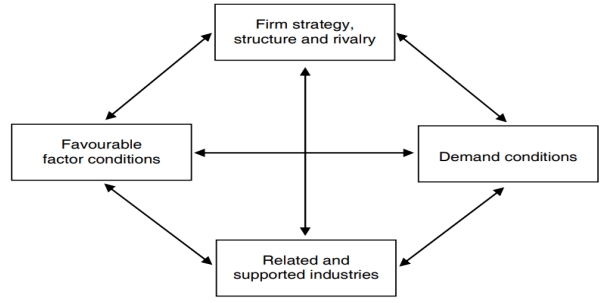
These factors collectively determine whether or not TCWL cables would be expensive relative to cables manufactured in other countries.
1. Favourable factor conditions
Factor conditions are the economic factors of production – land, labour, capital (equipment), and raw materials. Porter argues that the state and condition of these factors determine the extent to which a company can gain competitive advantage.
Factor conditions in a country can be divided into two categories: basic factors and advanced factors. Basic factors are factors of production that exist naturally in the country, such as land for agriculture, large quantities of natural materials, mineral resources such as oil and precious metals, and a favourable weather climate. Advanced factors are factors that are ‘created’ and developed over time, such as high labour skills and knowledge, technological resources, and infrastructure like transport networks.
In the case of TCWL:
- Ghana is rich in bauxite, the main raw material used in the production of aluminium ingot, which is processed into aluminium rods. This availability of bauxite gives TCWL some cost advantage in its production.
- On the other hand, copper has to be imported, leading to higher production costs.
- Additionally, advanced factors like the lack of local expertise in machine maintenance and high reliance on imported machinery also add to TCWL’s production costs. This puts TCWL at a disadvantage compared to competitors who might have better access to these resources locally.
2. Demand conditions in the home market
Demand conditions refer to the pressure home consumers bring to bear on companies and industries to produce high-quality, sophisticated, and innovative products at affordable prices. When local firms sell their products in global markets, the innovation and competitiveness fostered in the local market help them succeed internationally.
- TCWL serves sectors like energy transmission, mining, oil & gas, telecommunication, and manufacturing. These sectors demand high-quality products and ensure that TCWL maintains strict standards, which drives innovation and competitiveness.
- However, in sectors like real estate and households, there is low demand for quality products due to economic reasons, which leads to preference for cheaper, inferior imported products.
3. Related and supporting industries
These are the suppliers who provide inputs to help produce goods and services. The presence of competitive related and supporting industries can reduce costs and foster innovation.
- TCWL benefits from being located in Tema, which is the heart of industrialisation in Ghana and provides easy access to port services and transportation.
- However, TCWL faces challenges due to the lack of local expertise to maintain production machinery and the high cost of credit in Ghana. The increase in interest rates (from 22% to 38% in 2022) has made financing expensive, adding to TCWL’s production costs.
4. Firm strategy, structure, and rivalry
Porter suggests that rivalry between firms drives innovation and competitiveness.
- TCWL’s strategy has focused on producing high-quality cables and maintaining a nationwide distribution network to ensure that customers can easily access their products.
- The firm faces intense rivalry from both local producers and importers, which forces it to innovate and invest in research and development to stay competitive.
- The transition from a sole-shareholder structure to a public company structure, as proposed by the new CEO, may further boost TCWL’s ability to finance expansion and remain competitive on the international stage.
In conclusion, these four factors — favourable factor conditions, demand conditions, related and supporting industries, and firm strategy, structure, and rivalry — have shaped TCWL’s competitiveness in Ghana. As the company expands into Kenya and South Africa, management should evaluate how these factors apply in the new markets and adjust their strategy accordingly.