
Question
Answer
(A)
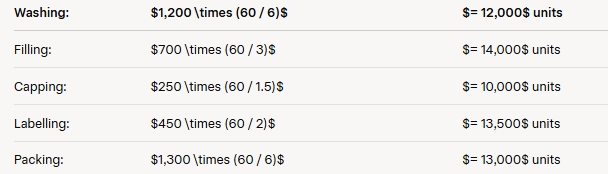 (B)
(B)
Throughput = Selling price – direct material
GH¢0.60 – GH¢0.18 = GH¢0.42
Time on bottleneck = 1.5 / 60 = 0.025 of an hour
Return per hour = GH¢0.42 / 0.025 = GH¢16.80
Total factory cost = Factory fixed costs + Direct labour costs
GH¢4,120 + (GH¢0.02 × 10,000) = GH¢4,320
Cost per hour = Total factory cost / total hours
GH¢4,320 / 250 hours = GH¢17.28 per hour
TA ratio = Return per hour / Cost per hour
16.80 / 17.28 = 0.972 (i.e. loss making)
Benefits
Products can be ranked in order of throughput contribution on the bottleneck resource to aid short-term production scheduling. This is a similar concept to maximising contribution per unit of limiting factor and aids decision making in the short term.
Throughput accounting can be used to identify (and then subsequently alleviate) bottlenecks in order to increase profit potential. Where bottlenecks cannot be eliminated, production must be limited to the capacity of the bottleneck resource in order to avoid the build-up of work in progress. This will help reduce unnecessary warehouse costs, the risk of inventory obsolescence and potential labour idle time and thus increase profit.
Limitations
Throughput accounting focuses on direct material costs and does not address the control of other costs. This may lead to cost inefficiencies and reduction in profit unless other methods (such as ABC) are adopted to address other costs such as labour and overheads.
Throughput accounting attempts to maximise throughput whereas traditional systems attempt to maximise profit. By attempting to maximise throughput, an organisation could be producing in excess of the profit-maximising output.