- 12 Marks
Question
b. ABC maintains the following standard cost card for product AB:
| Item | Standard Quantity | Standard Price | Total Cost (N) |
|---|---|---|---|
| Direct Material A | 3kg @ N8 per kg | N24 | |
| Direct Material B | 5kg @ N6 per kg | N30 | |
| Direct Labour | 2hrs @ N24 per hr | N48 | |
| Variable Overhead | 2hrs @ N9 per hr | N18 | |
| Total Standard Cost | N120 |
Actual Results for the Period:
- Actual production: 11,800 units
- Direct material A: 35,800kg @ N7.5 per kg = N268,500
- Direct material B: 62,000kg @ N7 per kg = N434,000
- Direct labour: 24,500 hours @ N25 per hour = N612,500
- Variable overhead: 24,500 hours @ N9 per hour = N220,500
Required:
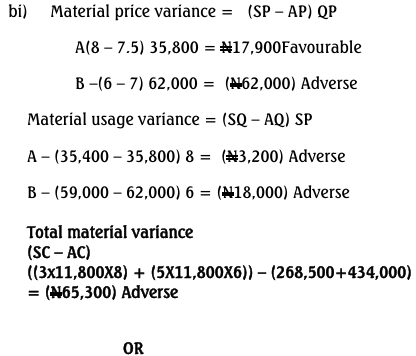
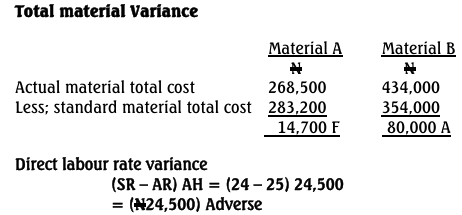
i. Calculate the following variances:
- Material price
- Material usage
- Total material
- Labour rate
(9 Marks)
ii. List TWO possible causes of each of the variances in (i) above. (3 Marks)
Answer


Material price variance
– Changes in market conditions that cause a general price increase for the
material.
– Failure of the purchasing department to seek most advantageous source
of supply
– Purchase of inferior quality materials bought at lower price
– Shortage of material necessitating buying at higher prices.
Material usage variance
– Careless handling of materials – Purchase of inferior quality materials
– Pilferage
– Changes in quality control requirements
– Changes in method of production
Direct labour rate variance
– Negotiated increase in rates not yet reflected in standard
– Unexpected overtime
– Use of a wrong standard rate for operations performed by workers paid with different rates
– Assignment of skilled labour to work normally performed by unskilled
labour.
- Tags: Labour Variance, Material Variance, Standard Costing, Variance Analysis
- Level: Level 1
- Topic: Basic Variance Analysis
- Series: NOV 2020
- Uploader: Dotse