
Question
Answer
a) Rights issue
b) Irredeemable bonds

c. Report to the Directors of ZY Plc
To: Directors of ZY Plc
From: Financial Consultant
Date: [Today’s Date]
Subject: Evaluation of Financing Options for New Machinery Investment
i. Comparison of Rights Issue and Bond Issue Methods of Raising Finance
The rights issue and bond issue methods provide distinct financing benefits and drawbacks:
- Rights Issue:
- Ownership Impact: A rights issue maintains the equity-only structure, avoiding additional debt and preserving a stable financial risk profile.
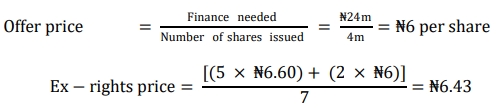
- Shareholder Wealth: Based on calculations, the ex-rights price (₦6.43) is slightly below the current cum-rights price (₦6.60), causing minimal dilution to share value.
- Control Considerations: By offering shares first to existing shareholders, control is preserved within the existing shareholder base, which may be a priority for the ZY family holding 40% of shares.
- Bond Issue:
- Leverage: Issuing 7.5% irredeemable bonds introduces financial leverage, which may enhance returns on equity but increases the financial risk, especially under fluctuating earnings.
- Cost Efficiency: Bonds incur lower costs initially due to the fixed interest (₦1.8 million annually) compared to dividends, but expose shareholders to the potential for decreased share value if debt levels appear unsustainable.
- Tax Benefits: Although tax was ignored in this scenario, interest payments on bonds would typically be tax-deductible, making bonds more advantageous in taxable environments.
In conclusion, a rights issue aligns well with ZY Plc’s conservative capital structure and dividend policy, minimizing risk and maintaining shareholder control, while the bond issue offers cost benefits at the expense of increased leverage and financial risk.
ii. Appropriateness of Alternative Methods of Issuing Equity Finance for ZY Plc
1. Placing:
- Overview: Involves selling shares to selected institutional investors at a predetermined price, often at a discount.
- Suitability: Low-cost and quick, but may be unsuitable for ZY Plc as it could reduce the control of the ZY family and increase institutional influence, which may not align with the company’s ownership goals.
2. Offer for Sale:
- Overview: Shares are sold to an issuing house, which then sells them to the public, either at a fixed price or through a tender.
- Suitability: Suitable for raising substantial funds from a broad investor base but is costly due to underwriting fees and advertising. It dilutes control more than a rights issue, which may not appeal to existing major shareholders like the ZY family.
3. Public Offer for Subscription:
- Overview: Shares are offered directly to the public by the company, without intermediaries.
- Suitability: While it raises public awareness and can attract diverse investors, it’s costly due to underwriting and marketing needs. It’s also time-consuming and may expose ZY Plc to market volatility, potentially conflicting with the immediate financing need.
In summary, given ZY Plc’s need for quick and cost-effective financing while preserving shareholder control, a rights issue remains the most appropriate method among the options considered.