- 20 Marks
Question
Binko Industrial Services plc is an all-equity financed and Stock Exchange-listed company. Recently, there have been changes at the board level, prompting a shift from conservative profit distribution to seeking new investment opportunities. In the financial year just ended, the company reported a profit of ₦50 million, similar to previous years. The company’s cost of equity is 15% per annum, and four investment projects have been identified, each with the same risk class as existing projects.
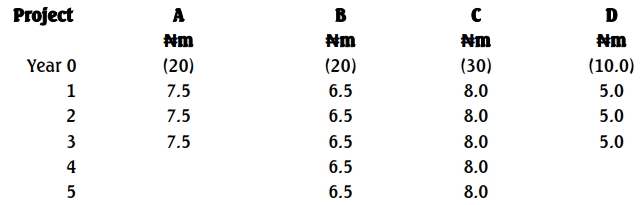
Required:
a. Calculate the dividend Binko Industrial Services plc should pay to shareholders in the financial year just ended, based on Modigliani and Miller’s 1961 proposition, ignoring taxation. (5 Marks)
b. Prepare notes for the board meeting, explaining Modigliani and Miller’s dividend policy proposition and reasons why the company may decide against the calculated dividend in (a). Your comments should address Binko’s circumstances. Work to the nearest ₦1,000. (15 Marks)
Answer
a. Dividend Calculation (5 Marks)
According to Modigliani and Miller’s dividend irrelevance theory, the company should pay dividends only after financing all positive Net Present Value (NPV) projects. Calculating the NPVs for each project at the company’s 15% cost of equity:
- Project A NPV: −20m+(7.5m×2.283) =−₦2.88m-
- Project B NPV: −20m+(6.5m×3.352) =₦1.79m
- Project C NPV: −30m+(8.0m×3.352) =−₦3.18m
- Project D NPV: −10m+(5.0m×2.283) =₦1.42m
Given the available capital, the company should invest in Projects B and D for a total of ₦30m, leaving a residual of:
Dividend=₦50m−₦30m=₦20m
Thus, Binko should pay ₦20 million as dividends.
b. Notes for Board Meeting (15 Marks)
Explanation of Modigliani and Miller Proposition:
Modigliani and Miller’s 1961 proposition on dividend policy states that, in perfect capital markets, the dividend policy of a company does not affect its value. Instead, the company’s value is determined by its investment policy and the profitability of its projects. Dividends should only be distributed if there are no positive NPV projects, as retained earnings can provide a cost-effective source of financing for profitable projects.
Reasons for Adjusting the Dividend Recommendation:
- Financing Investment Opportunities: The board may consider retaining earnings instead of paying a high dividend to fund new investments, especially if Binko aims to shift from conservative operations to expansion. Investing in profitable projects could generate future earnings and enhance shareholder value more effectively than a one-time dividend payout.
- Cash Flow Considerations: Paying a high dividend might strain the company’s cash flow, particularly if the investment projects require significant upfront cash. Maintaining a buffer would ensure financial flexibility and allow the company to respond to unforeseen expenses.
- Signaling and Shareholder Expectations: A sudden change in dividend policy could signal uncertainty or instability to shareholders accustomed to steady dividends. A phased approach or a partial payout might better align with shareholder expectations and the company’s long-term strategy.
- Risk and Project Viability: Given that the board has newly adopted an expansionary approach, there may be uncertainties in executing new projects successfully. Retaining more earnings could act as a safety net to manage potential project risks without compromising financial stability.
- Market Conditions and Competitive Positioning: Binko’s board might also consider how industry competitors are managing dividends and reinvestments. In a competitive market, reinvesting earnings to support growth or innovation might enhance Binko’s market position and appeal to long-term investors.
- Topic: Dividend Policy
- Uploader: Kofi