Assume today is November 20, 2019. In 2018, the Oyin Division of Aba plc successfully launched a new premium wine, “Aladun,” in Nigeria. The Divisional Board of Oyin Division is now considering plans put forward by the Divisional Marketing Manager to launch the full range of Aladun in another country, “Linder.” Linder has the Linderian dollar (L$) as its currency, and the launch is planned for January 1, 2020.

It is known that breaking into the Linderian market for fruit wine is challenging due to strong local brand loyalty. Initial market research based on free tasting sessions has been promising, though uncertainties remain. The biggest risk identified is the potential for a Nigerian competitor to enter the same market with a similar product.

Financial Data for the Project:

  • Initial market research for the Linderian market: N5 million (already spent).
  • Additional detailed market research and packaging design (if approved): N20 million.
  • Launch campaign (radio and TV advertising): N10 million.
  • Distribution center in Linder: L$84 million.

Operating cash flow forecasts for the year ending December 31, 2020, vary based on two scenarios:

  • Scenario A: Sales revenue L$100 million; costs L$10 million + N20 million.
  • Scenario B: Sales revenue L$55 million; costs L$10 million + N15 million.
  • Probability of occurrence: 70% for Scenario A, 30% for Scenario B.

Other relevant financial data:

  • Oyin Division’s project evaluation discount rate: 15%.
  • Project duration: 4 years.
  • Expected operating cash flow growth: 5% per year.
  • Residual value of the distribution center: L$52 million after 4 years.
  • Exchange rate: N1 = L$1.2000 on January 1, 2020 (strengthening by 2% per year).
  • Corporate tax rate in Nigeria: 35%.
  • Tax allowances on capital expenditure: 100% (tax-deductible in Nigeria).

Additional Option:

  • The project could be abandoned on January 1, 2021, with the distribution center sold for an estimated L$70 million if Scenario B occurs.

Required:

a. Ignoring the abandonment option: i. Calculate the NPV for the project as of January 1, 2020, for each scenario and the overall total expected NPV. (17 Marks) ii. Calculate the payback period for each scenario. (4 Marks) iii. Interpret your results. (4 Marks)

b. Evaluate the abandonment decision on January 1, 2021, if Scenario B occurs. (7 Marks)

c. Advise on how real options and other strategic financial issues may influence the investment decision. (8 Marks)

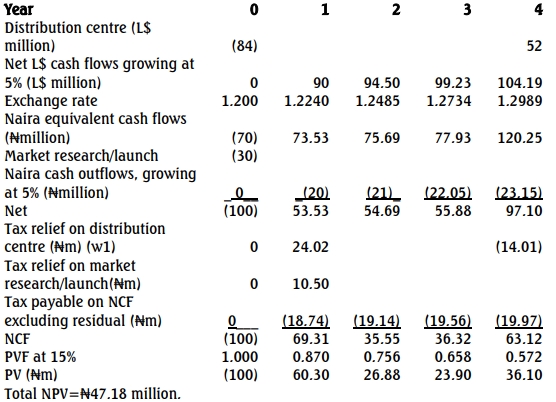
a.(i). Scenario A

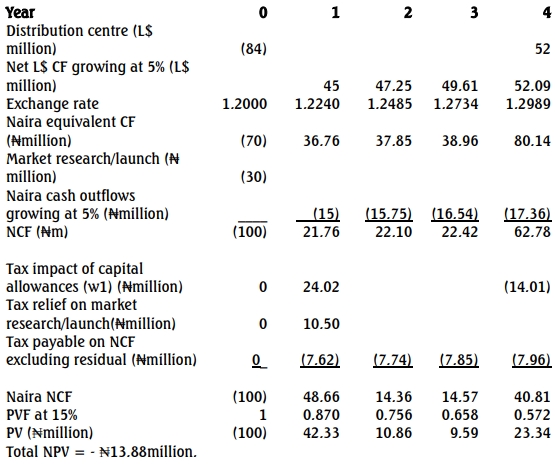
Scenario B

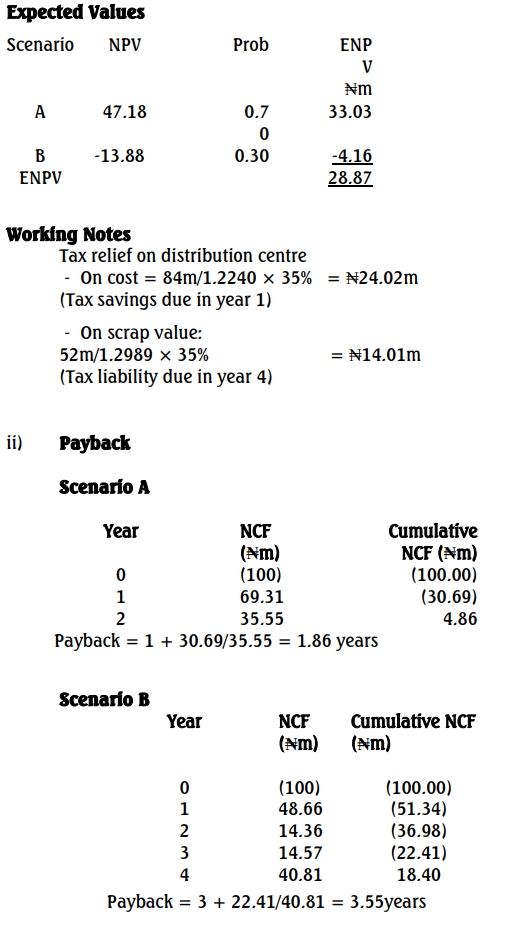
iii. Interpretation of Results:

  • Scenario A shows a positive NPV with a shorter payback period, indicating a favorable investment if high demand materializes.
  • Scenario B has a longer payback and lower NPV, highlighting risks in a conservative market response.
  • The project may proceed if weighted NPV remains positive, taking Scenario A’s higher probability into account.

b. Abandonment Option Evaluation:

  • If Scenario B unfolds, the project can be abandoned on January 1, 2021, with the distribution center sold for L$70 million.
  • Calculate the abandonment option’s PV by assessing cash flows saved and capital recovered compared to continuing with Scenario B.
  • Conclusion: Abandonment may mitigate losses but also forfeits potential growth if Scenario B improves over time.

c. Real Options and Strategic Financial Issues:

  • Real Options: The abandonment option acts as a safety net but has limited influence initially. Other options like “wait” and “follow-on” are considered:
    • Wait: Risky due to market lead concerns if competitors enter first.
    • Follow-on: Success in Linder could lead to further expansions, enhancing long-term value.
  • Strategic Issues: Financing availability, shareholder impacts, gearing, risk appetite, and potential market reputation must be considered.
online
Knowsia AI Assistant

Conversations

Knowsia AI Assistant