Tamilore Limited (TL) is an agro-based firm, specializing in yam and rice production in Benue State of Nigeria. One of the harvesters is due to be replaced on November 30, 2018, the last day of TL’s current financial year. An investment appraisal exercise has recently been completed which confirmed that it is financially beneficial to replace the machine at this point. TL is now considering how best to finance the acquisition of the harvester to be replaced. TL is already highly geared.

A government development agency has offered the following two alternative methods of financing the machine:

Alternative 1
A loan of N49,200,000 at 6% interest rate to buy the machine on November 30, 2018. If this option is selected, the machine will be depreciated on a straight-line basis over its estimated useful life of 5 years.

Alternative 2
Enter into a finance lease. This will involve payment of annual rental of N12 million with the first payment due on November 30, 2019. The lease payments will be for the entire estimated useful life of the machine, which is 5 years, after which ownership will pass to TL without further payment.

Other information

(i) Whether leased or purchased outright, maintenance would remain the responsibility of TL and would be N450,000 payable annually in advance.
(ii) TL is liable to tax at a rate of 25%, payable annually at the end of the year in which the tax charge or tax saving arises.
(iii) TL is able to claim capital allowances on the full capital cost of the machine in equal installments over the first four years of the machine.
(iv) Assume that TL has sufficient taxable profits to benefit from any savings arising therefrom.
(v) All workings in N’000.

Required:

a. Show that the implied interest rate in the lease agreement is 7%. (3 Marks)

b. Advise, using present value method, whether Tamilore Limited should borrow to buy the machine or lease it. (12 Marks)

c. Instead of lease financing, one director has suggested an equivalent Islamic finance.

i. Explain briefly the principles of Islamic finance. (2 Marks)

ii. Explain three main advantages of Islamic finance. (3 Marks)

a) Implied interest rate in the lease

Cost of machine/annual lease rental = N49,200/N12,000 = 4.100
From the annuity table under ‘5 years’, this gives an implied rate of 7%.

Candidates can also use IRR to determine the implicit interest rate using the following figures.

Year Cash Flow (N’000)
0 (49,200)
1-5 12,000

However, the method is longer.

b) Evaluation of Financing Options

In the following evaluation of the financing options, the following items are ignored because they are common to the two alternatives:

i) tax savings on capital allowances; and
ii) maintenance charges and related tax savings.

Alternative 1 – Outright purchase

The net relevant cost is the purchase cost of N49,200,000.

Alternative 2 – Lease finance

  • After-tax cost of borrowing = 6% x (1 – 0.25) = 4.5%

Interest component of lease rental (N’000):
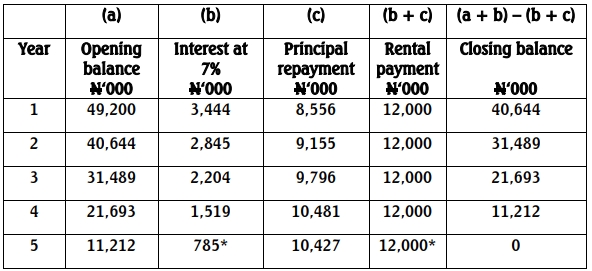
(* rounded up)

NPV of lease option in (N’000):
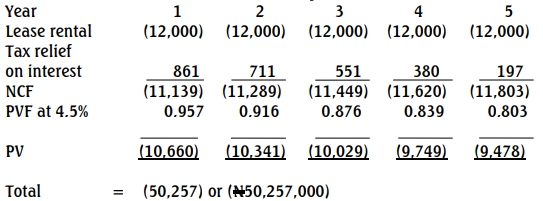
Recommendation

An outright purchase of the machine at a cost of N49,200,000 is relatively cheaper and therefore recommended.

c) Islamic Finance Alternative

i) Principles of Islamic Finance

  • Wealth must be generated from legitimate trade and asset-based investment (the use of money for the purposes of making money is expressly forbidden).
  • Investment should have a social and an ethical benefit to the wider society beyond pure return.
  • Risk should be shared.
  • Harmful activities (haram) should be avoided.

The intention is to avoid injustice, asymmetric risk, moral hazard, and unfair enrichment at the expense of another party.

ii) Advantages of Islamic Finance

  • Gharar (uncertainty, risk of speculation) is not allowed, reducing the risk of losses.
  • Excessive profiteering is not allowed; only reasonable mark-ups are permitted.
  • Banks cannot use excessive leverage and are therefore less likely to collapse.
  • The rules encourage all parties to take a longer-term view and focus on creating a successful outcome for the venture, which should contribute to a more stable financial environment.
  • The emphasis of Islamic finance is on mutual interest and cooperation, with a partnership based on profit creation through ethical and fair activity benefiting the community as a whole.