- 15 Marks
Question
a. Capital Asset Pricing Model (CAPM) is an equilibrium model of the trade-off between expected portfolio return and unavoidable risk.
What are the basic assumptions on which this model is based? (6 Marks)
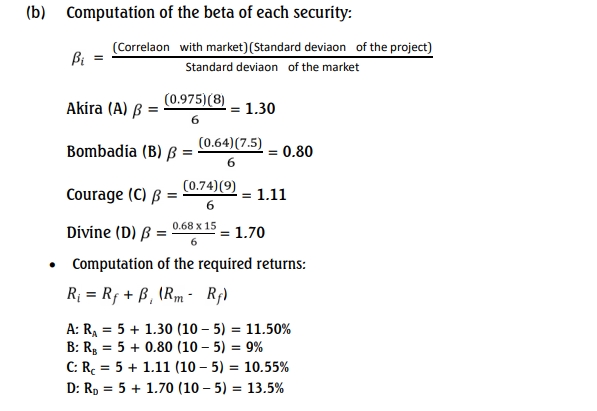
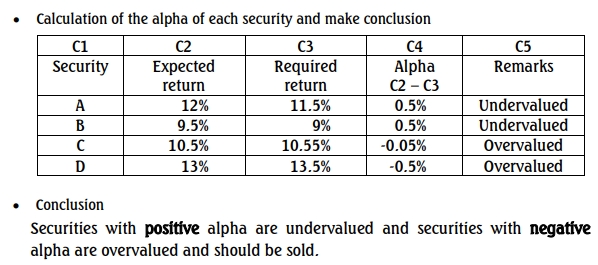
b. Currently, the rate of return on the Federal Government Bond redeemable at par in the year 2018 is 5%. The securities of four companies, Akira Plc., Bombadia Plc., Courage Plc., and Divine Plc., have expected returns of 12%, 9.5%, 10.5%, and 13%, respectively. The average expected return on the market portfolio is 10%, subject to a 6% risk (standard deviation). Other relevant information relating to the four securities of the companies is as stated below:
| Company | Standard Deviation | Correlation Coefficient |
|---|---|---|
| Akira Plc | 0.080 | 0.975 |
| Bombadia Plc | 0.075 | 0.640 |
| Courage Plc | 0.090 | 0.740 |
| Divine Plc | 0.150 | 0.680 |
You are required to show which of the companies is/are overvalued. (9 Marks)
Answer
a Basic Assumptions of CAPM
- Investors are Rational and Risk-Averse: Investors aim to maximize returns for a given level of risk or minimize risk for a given level of return.
- Markets are Perfectly Competitive: No investor can influence market prices. There are no transaction costs or taxes.
- Homogeneous Expectations: All investors have the same expectations of risk and return for a given security.
- Single Period Horizon: All investors plan for the same single period investment horizon.
- Free Borrowing and Lending: Investors can borrow or lend unlimited funds at a risk-free rate.
- Risk is Measured by Variance: Risk of securities is determined by the variance or standard deviation of returns.
(6 Marks)
- Tags: Assumptions, CAPM, Market Portfolio, Portfolio analysis, Risk-Return Trade-Off, Valuation
- Level: Level 3
- Topic: Portfolio Management
- Series: NOV 2016
- Uploader: Dotse