
Question
The directors of Jindadi Plc. (JP), an Abuja-based entertainment company, are currently considering the appropriate cost of capital to use in appraising capital investments. It is the policy of the company to assess the financial viability of all capital projects using the net present value criterion.
You have been provided with some financial information about the company.
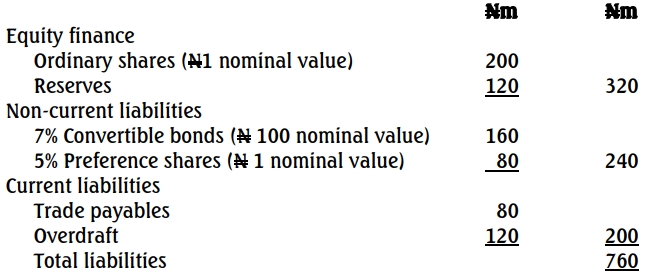
JP has an equity beta of 1.2, and the ex-dividend market value of the company’s equity is N1 billion. The ex-interest market value of the convertible bonds is N168 million, and the ex-dividend market value of the preference shares is N50 million.
The convertible bonds of JP have a conversion ratio of 19 ordinary shares per bond. The conversion date and redemption date are both on the same date in five years’ time. The current ordinary share price of JP is expected to increase by 4% per year for the foreseeable future.
The equity risk premium is 5% per year, and the risk-free rate of return is 4% per year. JP pays profit tax at an annual rate of 30% per year.
Required:
a. Calculate the market value after-tax weighted average cost of capital of JP, explaining clearly any assumptions you make. (10 Marks)
b. Discuss why market value weighted average cost of capital is preferred to book value weighted average cost of capital when making investment decisions. (5 Marks)
Answer
Market Value After-Tax Weighted Average Cost of Capital (WACC) Calculation:
- Cost of Equity (KE) using CAPM:
- Formula: KE = RF + βE × (RM – RF)
- Given:
Risk-Free Rate (RF) = 4%
Equity Beta (βE) = 1.2
Equity Risk Premium (RM – RF) = 5% - Calculation:
KE = 4% + (1.2 × 5%) = 10%.
- Cost of Convertible Bonds (KD):
- Conversion Value in Year 5:
Conversion Ratio = 19 shares per bond
Share Price Growth = 4% annually
Year 5 Share Price = 5 × (1.04)^5 = N6.08
Conversion Value = 19 × 6.08 = N115.52 - After-Tax Interest Payment:
Coupon Rate = 7%
Tax Rate = 30%
Interest Payment = 7% × 100 × (1 – 0.3) = N4.90 per bond. - Yield Calculation via Interpolation:
Using interpolation, After-Tax KD = 6.43%.
- Conversion Value in Year 5:
- Cost of Preference Shares (KP):
- Formula: KP = Preference Dividend / Preference Share Price.
- Given:
Dividend Rate = 5%
Nominal Value = N80 million
Market Value = N50 million. - Calculation:
KP = (5% × N80m) / N50m = 8%.
- WACC Calculation:
- Market Values:
Equity = N1,000m
Convertible Bonds = N168m
Preference Shares = N50m
Total Value = 1,218m. - Weights and Costs:
- Market Values:

Assumptions:
- Overdraft is ignored in WACC calculation as it is a short-term liability and may not significantly impact long-term investment appraisal.
- Convertible bonds are assumed to be converted since conversion value is higher than redemption value
Why Market Value Weighted Average Cost of Capital (MV WACC) is Preferred Over Book Value WACC:
- Reflects Current Market Conditions:
- Market values reflect real-time conditions in capital markets, which are crucial for investment appraisal.
- Accurate Representation of Cost Components:
- The market value of equity is often higher than its book value. Using book values underestimates the importance of equity cost, which is typically higher than debt cost.
- Better Investment Decisions:
- If book values are used, WACC is lower, leading to acceptance of sub-optimal projects.
- Market value WACC ensures accurate discount rates for evaluating cash flows.
- Debt Valuation Accuracy:
- Bonds trade near nominal value, so using book or market value for debt has a smaller impact. However, book values for equity skew results significantly.
Conclusion:
Market value WACC is a more reliable metric for determining the cost of capital and making sound investment decisions