LL Plc. is a large engineering company. Its ordinary shares are quoted on the Stock Exchange.

LL Plc.’s Board is concerned that the company’s gearing level is too high and that this is having a detrimental impact on its market capitalisation. As a result, the Board is considering a restructuring of LL Plc.’s long-term funds, details of which are shown here as at 28 February, 2017:

Funding Source Total Par Value (₦m) Market Value
Ordinary Share Capital (50k) 67.5 ₦2.65/share ex-div
7% Preference Share Capital (₦1) 60.0 ₦1.44/share ex-div
4% Redeemable Debentures (₦100) 45.0 90% ex-int

The debentures are redeemable in 2022. LL Plc.’s earnings for the year to 28 February, 2017 were ₦32.4 million and are expected to remain at this level for the foreseeable future. Retained earnings, as at 28 February, 2017 were ₦73.2 million.

The Board is considering a 1 for 9 rights issue of ordinary shares, and this additional funding would be used to redeem 60% of LL Plc.’s redeemable debentures at par. However, some of LL Plc.’s directors are concerned that this issue of extra ordinary shares will cause the company’s ordinary share price and its earnings per share (EPS) to fall by an excessive amount, to the detriment of LL Plc.’s shareholders. Accordingly, they are arguing that the rights issue should be designed so that the EPS is not diluted by more than 5%.

The Directors wish to assume that the income tax rate will be 21% for the foreseeable future and the tax will be payable in the same year as the cash flows to which it relates.

Required:
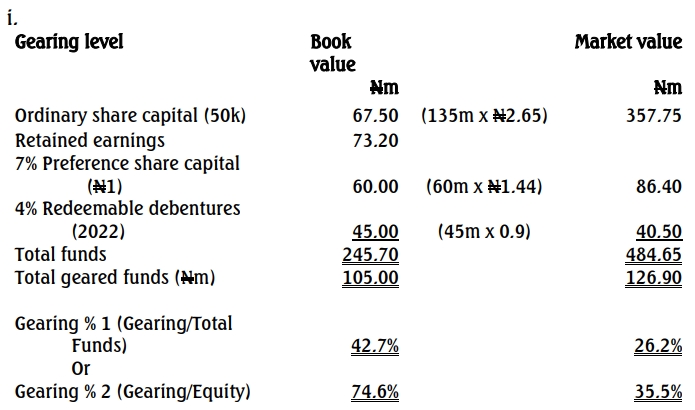
a. i. Calculate LL Plc.’s gearing ratio using both book and market values. (5 Marks)

ii. Discuss, with reference to relevant theories, why LL Plc.’s Board might have concerns over the level of gearing and its impact on LL Plc.’s market capitalisation. (6 Marks)

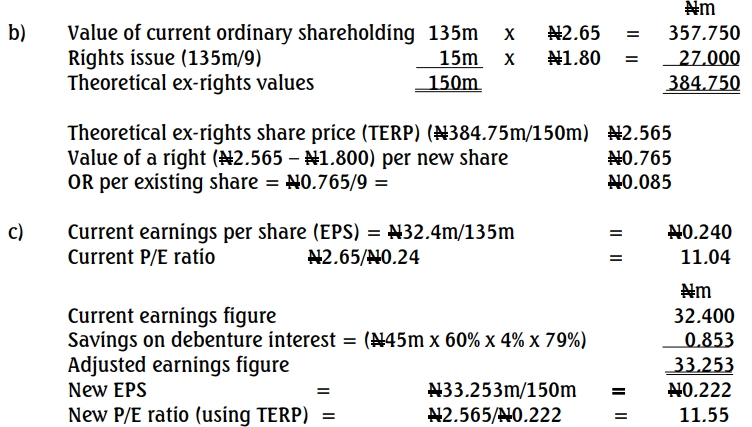
b. Assuming that a 1 for 9 rights issue goes ahead, calculate the theoretical ex-rights price of LL Plc.’s ordinary share and the value of a right. (3 Marks)

c. Discuss the Directors’ view that the rights issue will cause the share price and the EPS to fall by an excessive amount, to the detriment of LL Plc.’s ordinary shareholders. Your discussion should be supported by relevant calculations. (6 Marks)

(a)

Traditional View

Loan financing is considered advantageous because:

  1. It is associated with relatively low risk.
  2. The interest payments are tax-deductible, which reduces the effective cost of borrowing.

Implications on Weighted Average Cost of Capital (WACC):

  • As gearing increases, WACC initially decreases due to the low cost of debt and its tax benefits.
  • At moderate levels of gearing, shareholders and lenders are unconcerned about increased risk.
  • Beyond a certain point, the increasing risk leads to higher required returns for both equity and debt, causing WACC to rise.
  • Optimal Level of Gearing: This is the point where WACC is at its minimum, and the value of equity is maximized.

Modigliani and Miller (M&M) View

Position in 1958 (Ignoring Taxes):

  • Shareholders are immediately concerned by the existence of any gearing, as they perceive increased financial risk.
  • The cost savings from cheaper loan finance are offset by a proportional increase in the cost of equity, leading to a constant WACC at all levels of gearing.
  • Conclusion: There is no optimal level of gearing. Managers should not prioritize gearing decisions, as the value of a geared company VgV_g equals the value of an ungeared company VuV_u:

Vg=VuV_g = V_u

Position in 1963 (Considering Taxes):

  • With tax benefits, the cost of debt is reduced further, making WACC decline as gearing increases.
  • The value of a geared company increases by the present value of the tax shield on debt:

Vg=Vu+DTV_g = V_u + DT

Where DTDT is the tax shield.

  • Conclusion: All-debt financing is optimal due to its tax advantages.

Modern View

While acknowledging the M&M argument about tax benefits, the modern view incorporates the potential downsides of excessive gearing:

  1. Bankruptcy Costs:
    • At high levels of gearing, investors become concerned about the likelihood of enforced liquidation or bankruptcy.
    • These concerns increase the required returns on both equity and debt, driving up the WACC.
  2. Interest Rate Increases:
    • As gearing rises, lenders demand higher interest rates to compensate for the added financial risk.

Conclusion:

  • Gearing should be increased only to the point where the benefits of tax relief are balanced by the potential costs of financial distress and increased interest rates.
  • At this point, WACC is at its minimum, and the value of the business is maximized.
Conclusion on LL Plc.’s Gearing Concerns

The directors of LL Plc. are likely concerned that:

  1. The current level of gearing is beyond the optimal point where WACC is minimized. This would mean the financial risks associated with high gearing are outweighing the tax benefits.
  2. As an engineering company, LL Plc. faces high operational risks, and additional financial risk from high gearing could further jeopardize its stability.
  3. Alternatively, the directors may be mistakenly focusing on the book value gearing ratio, which could exaggerate the level of financial risk, as the market value ratio suggests a less critical position.

The earnings per share figure will fall by 7.5% (from N0.240 to N0.222).