- 20 Marks
Question
Eko Product Plc (EP Plc) is a producer of a variety of vegetable oil and other household products in Lagos. The company presently faces significant competition in the market for one of its major raw materials – palm oil. To secure a regular flow of the raw material, the Directors of EP Plc are now considering making an offer for the entire share capital of Benin Oil Plc (BO Plc), a palm oil producing company in Benin.
The following financial information is provided for the two companies:
| Parameter | EP Plc | BO Plc |
|---|---|---|
| Equity beta | 1.2 | 1.2 |
| Asset beta | 0.9 | 1.2 |
| Number of shares (million) | 210 | 200 |
| Current share price | N29 | N12 |
It is thought that combining the two companies will result in several benefits. It is estimated that combining the two companies will generate free cash flow to the firm (FCFF) of N1,080 million in current value terms, but these will increase by an annual growth rate of 5% for the next four years before reverting to an annual growth rate of 2.25% in perpetuity. In addition to this, combining the companies will result in cash synergy benefits of N100 million per year for the next four years. These synergy benefits are not subject to any inflationary increase, and no synergy benefits will occur after the fourth year.
The debt-to-equity ratio of the combined company will be 40:60 in market value terms and it is expected that the combined company’s cost of debt will be 4.55% before tax.
The income tax rate is 20%, the current risk-free rate of return is 2%, and the market risk premium is 7%. It can be assumed that the combined company’s asset beta is the weighted average of EP Plc’s and BO Plc’s asset betas weighted by their current market values.
EP Plc has offered to acquire BO Plc through a mixed offer of one of its shares for two BO Plc shares, plus a cash payment, such that a 30% premium is paid for the acquisition. Shareholders of BO Plc feel that a 50% premium would be more acceptable. EP Plc has sufficient cash reserves if the premium is 30%, but not if it is 50%.
You are required to:
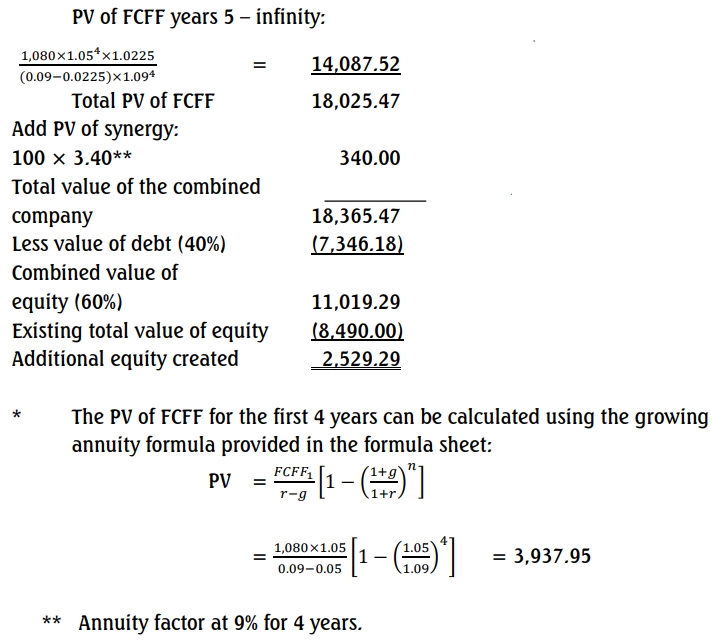
(a) Estimate the additional equity value created by combining EP Plc and BO Plc based on the free cash flow to firm method. Comment on the results obtained and discuss briefly the assumptions made. (11 Marks)
(b) Estimate the impact on EP Plc’s equity holders if the premium paid is increased to 50% from 30%. (5 Marks)
c. Estimate the additional funds required if a premium of 50% is paid instead of 30% and discuss how this premium could be financed. (4 Marks)
Answer
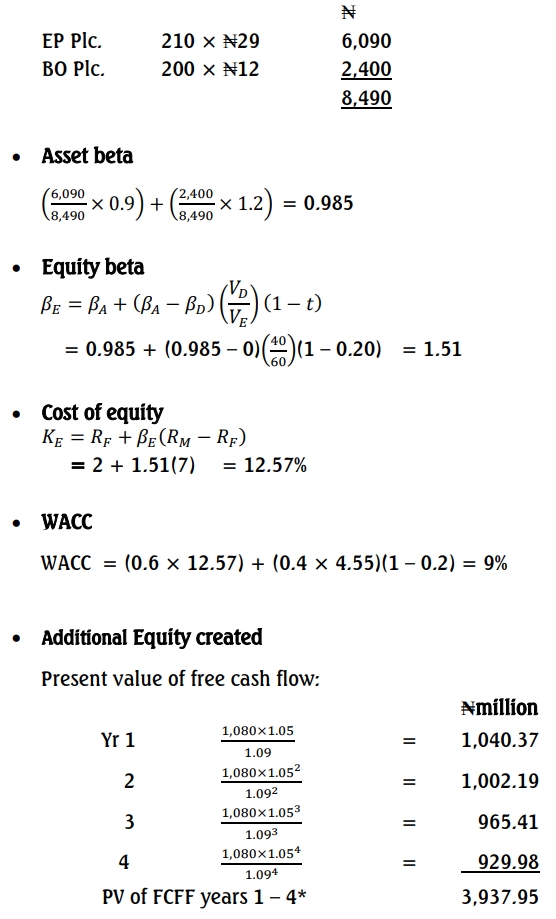
a) ● Current market value


Comments
Although the equity beta and the risk of the combined company is more than that of EP Plc. on its own, probably due to BO Plc’s higher business risk (reflected by the higher asset beta), overall the benefits from growth in excess of the risk free rate and additional synergies have led to an increase in the value of the combined company.
However, a number of restrictive assumptions have been made in obtaining the valuation, for example:
• the assumption of growth of cash flows in perpetuity may be unrealistic;
• whether the calculation of the combined company’s asset when based on the weighted average of the market values is based on good evidence or not; and
• the given figures such as growth rates, tax rates, free cash flows, market risk premium, etc. are realistic or not.
In all, it may be necessary to undertake sensitivity analysis to determine how changes in the variables would impact on the value of the combined company.
b) Purchase consideration of BO Plc.:
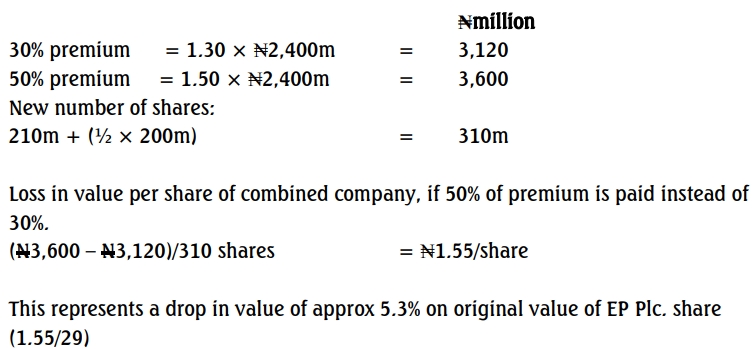
c) The amount of additional cash is about ₦480 million, if EP Plc. agrees to the demand made by BO Plc.’s shareholders and pays the 50% premium. EP Plc. has a number of options to raise the ₦480 million:
i) The company could take on additional loan. But this will increase financial leverage and the WACC, which in turn will reduce the value of the company.
ii) EP Plc. could raise the amount by issuing additional equity capital, but the existing shareholders may not see this as a positive development.
iii) EP Plc. could offer a higher proportion of its shares in the share-for-share exchange instead of paying cash for the additional premium – but this will lead to further dilution of the equity holding of the existing shareholders of EP Plc.
It is however necessary to consider whether the shareholders of BO Plc. would consider, more of cash or more of equity shares?
- Tags: Acquisition, Equity Value, Free Cash Flow, Premium, Shareholder Impact, Synergies
- Level: Level 3
- Topic: Mergers and acquisitions
- Uploader: Kofi