Katam Pie has adopted a strategy of diversification into many different industries in order to reduce risk for the company’s shareholders. This has resulted in frequent changes in the company’s gearing level and widely fluctuating risks of individual investments. Presently, the company has a target debt-to-asset ratio i.e., D/(E + D) of 25%, an equity beta of 2.25, and a pre-tax cost of debt of 5%.

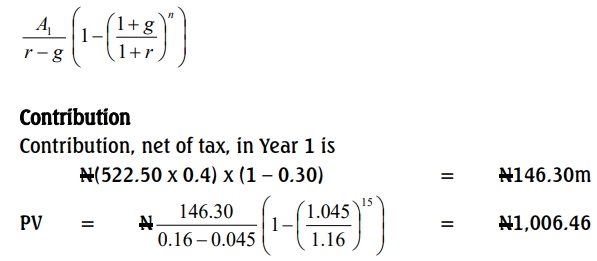
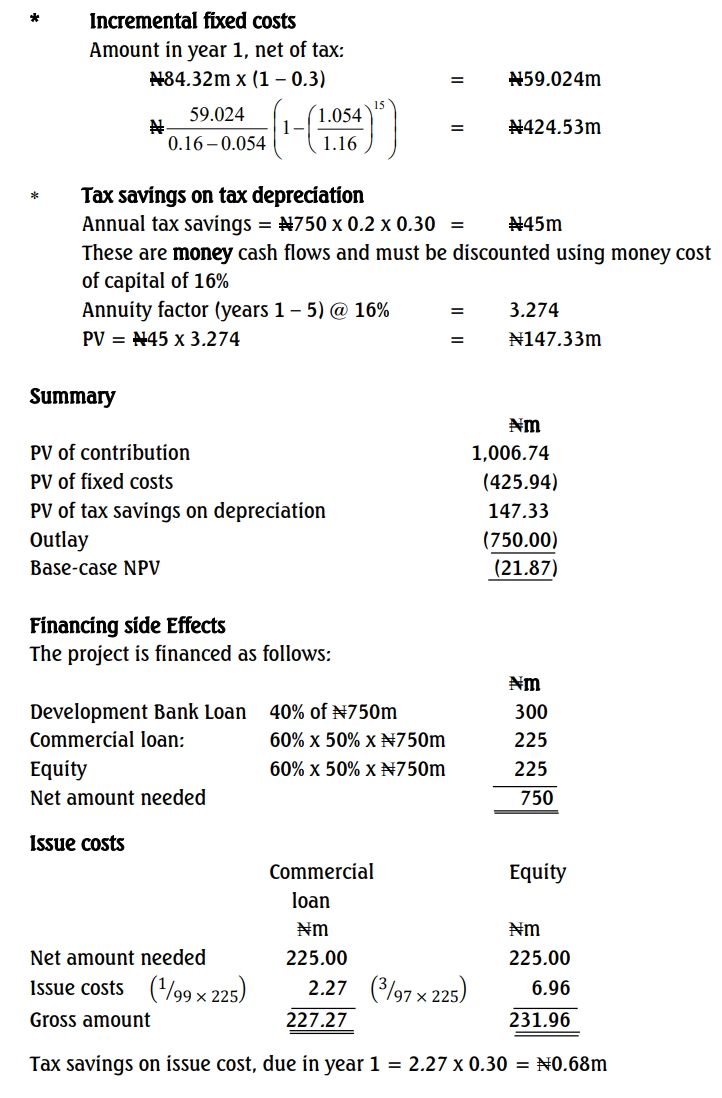
On January 1, 2016, Katam Plc with a year-end of December 31, is considering the purchase of a new machine costing N750million, which would enable it to diversify into a new line of business. The new business will generate sales of N522.50million in the first year, growing at 4.5% p.a. A constant contribution margin ratio of 40% can be expected throughout the 15-year life of the project. Incremental fixed cash costs will be N84.32million in the first year, growing by 5.4% p.a.

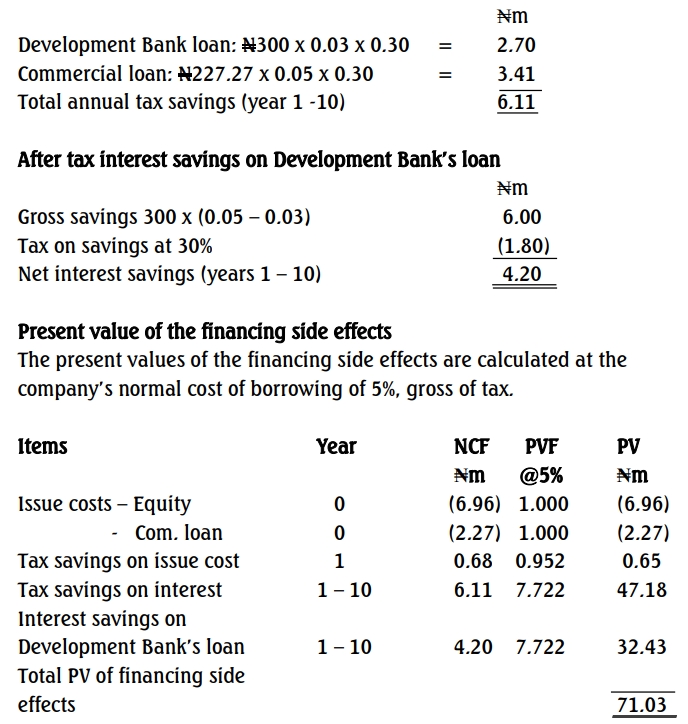
A regional development bank has offered a 10-year loan of 3% interest to finance 40% of the cost of the machine. The balance of 60% will be financed equally by a 10-year commercial loan (with annual interest of 5%) and a fresh round of equity. The issue cost on the commercial loan will be 1%, and the new equity will incur an issue cost of 3%. All issue costs are on the gross amount raised for the respective capital. Issue costs on debt are allowed for tax purposes.

A firm that is already in the business of the new project has a gearing ratio of 20% (debt to asset) and a cost of equity of 18.1%. Its corporate debt is risk-free.

The tax rate is 30% payable in the year the profit is made. Tax depreciation of 20% on cost is available on the new machine. Katam Pie has a weighted average cost of capital of 14% and a cost of equity of 17.5%. The risk-free rate is 4%, and the market risk premium is 7%.

You are required to:

  1. Estimate the Adjusted Present Value (APV) and advise whether the project should be accepted? (21 Marks)
  2. Explain:
    i. The circumstances under which the use of APV is appropriate. (5 Marks)
    ii. The major advantages and limitations of the use of the APV method. (4 Marks)

Growing annuity can be used to calculate the present value of each of the items involving growth (inflation). As given in the formula sheet, the present value of growing annuity is given by:
Note: In calculating the present values of the financing cash flows, the
discount factor used is 5% to reflect the normal borrowing/default risk
of the company.
Alternatively, the risk-free rate of 4% could be used depending on the
assumption made. Credit will be given where these are used to
estimate the discount factor.
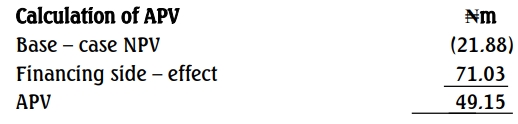
Recommendation
The project has a negative NPV when financed purely by equity, but the financing side effects make the APV positive. Therefore, the project should be accepted as it is expected to increase shareholder wealth by N49.15 million.

(b) Explanation:

i. Circumstances for Using APV

  • When a project permanently changes the company’s gearing level.
  • Projects involving unusual financing arrangements like subsidized loans.
  • When the project significantly alters the company’s debt capacity.
  • When considering multiple project-specific financing options.

ii. Advantages of APV

  • Provides a clear distinction between operating cash flows and financing side effects.
  • More accurate assessment of real project worth.
  • Fewer recalculations needed for capital structure changes.

Limitations of APV

  • Requires precise identification and quantification of all financing side effects.
  • The methodology assumes perpetuities for cash flows, which may not always apply.
  • The M&M-based approach ignores bankruptcy costs, tax exhaustion, and agency costs.