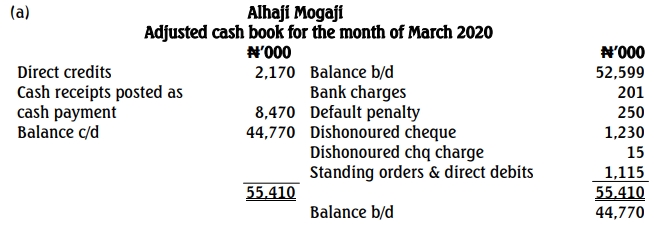
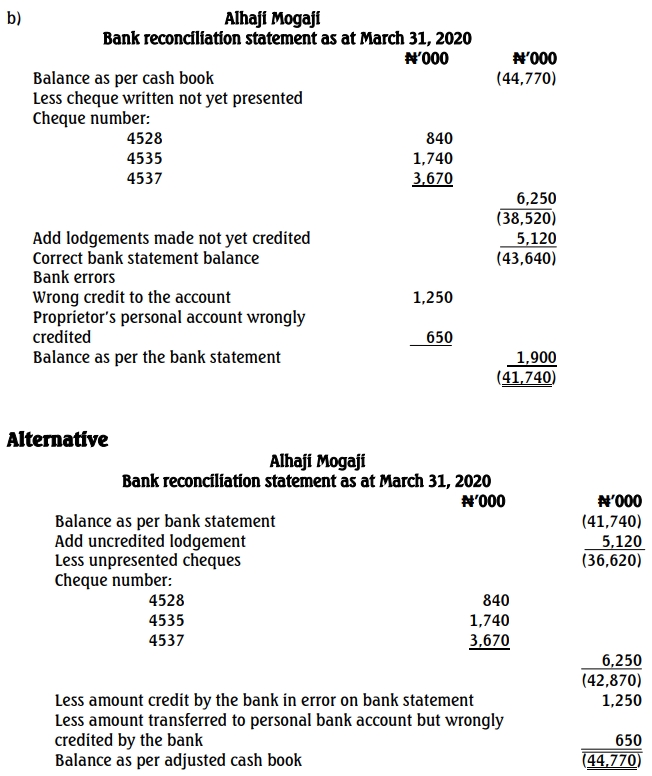
On April 6, 2020, Alhaji Mogaji received his bank statement for the month ended March 31, 2020. The bank statement showed a balance of N41,740,000 (overdraft) as at March 31, while the cash book showed a balance of N52,599,000 (credit) as at that date. On examination of the cash book and the bank statement the following were discovered:

  1. Bank charges of N201,000 had not been recorded in the cash book.
  2. Alhaji Mogaji exceeded his overdraft limit during the month of March. The bank had therefore charged him a default penalty of N250,000. This was not reflected in the cash book.
  3. A sum of N1,250,000 had been credited to Alhaji Mogaji’s bank account in error.
  4. A cheque for N1,230,000 had been returned by the bank as dishonoured. In effect, the bank charged Alhaji Mogaji N15,000, which was not reflected in the cash book.
  5. Cash receipts of N3,740,000 were posted as cash payments of N4,730,000 in the cash book.
  6. On March 21, Alhaji Mogaji transferred cash of N650,000 to his personal bank account, but this was credited to the business bank account in error by the bank.
  7. Standing orders and direct debits of N1,115,000 had not been posted to the cash book.
  8. Customers had transferred N2,170,000 directly to the bank account. The credit alert was received, but no record had been made in the cash book.
  9. An amount of N5,120,000 lodged to the bank account on March 31, 2020, had not been credited by the bank.
  10. The following cheques drawn on the bank account had not been presented for payment as at March 31, 2020:
  • Cheque No: 4528, March 11, 2020, for N840,000
  • Cheque No: 4535, March 28, 2020, for N1,740,000
  • Cheque No: 4537, March 31, 2020, for N3,670,000

You are required to:
a. Prepare the adjusted cash book for the month of March 2020. (9 Marks)
b. Prepare a statement on March 31, 2020, reconciling the bank statement balance with the adjusted cash book balance. (7 Marks)
c. Explain TWO reasons for preparing a bank reconciliation statement on a regular basis. (4 Marks)

c. Reasons for preparing a bank reconciliation statement on a regular basis:

  1. To detect errors on either the cash book or bank statement.
  2. To ensure that the balance used in the financial statements is accurate by determining the final cash book balance.