- 20 Marks
Question
The Central Bank of Kangora (CBK) operates a post-employment benefit plan whereby employees are entitled to an amount upon completion of employment. Each employee is paid an amount equal to 150% of the annual pay at the time of retirement multiplied by the number of years in service. The plan is not funded.
CBK uses a professional actuary to determine its liability under the plan at the end of every reporting period. The report of the actuary shows that the plan obligation was ₦620 million and ₦906 million as at 1 January, 2018 and 31 December, 2018 respectively. The current and past service cost for the year was ₦108 million. The discount rates were 8% and 12% as at 1 January, 2018 and 31 December, 2018 respectively.
CBK paid a total benefit of ₦48 million during the year.
The financial controller is struggling to complete the reconciliation and accounting entries for the plan. He is particularly confused about the concept of re-measurement and its accounting treatment.
Required:
a. Differentiate between a defined contribution plan and a defined benefit plan and advise CBK on how its post-employment plan should be classified. (5 Marks)
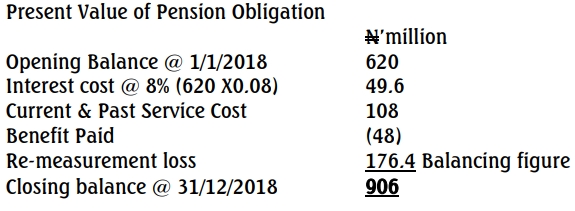
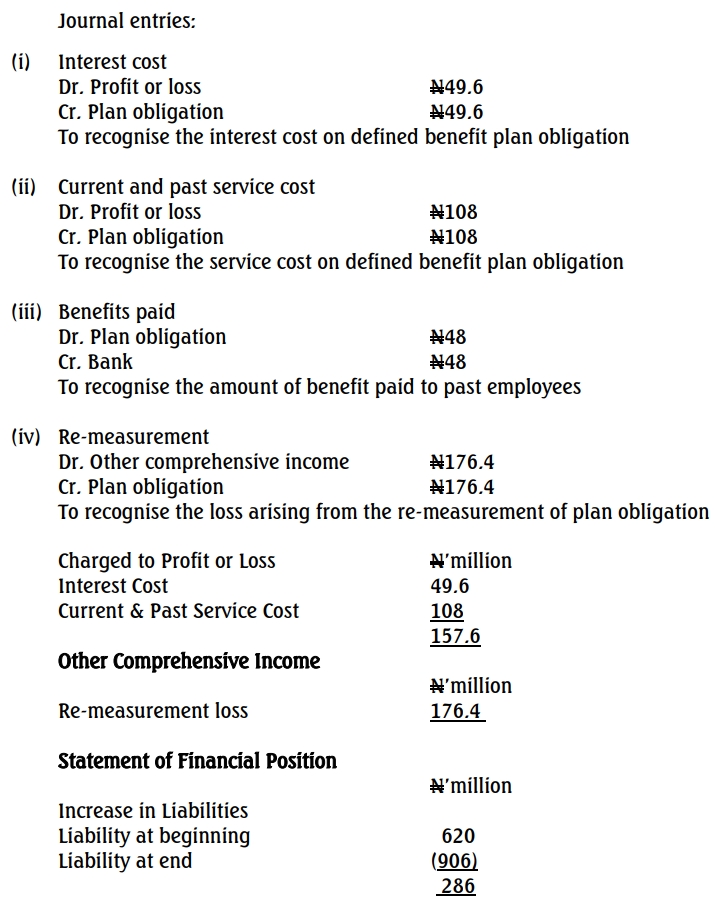
b. Complete the reconciliation and show the journal entries required to record the transactions for the year ended 31 December, 2018. (10 Marks)
c. Discuss the components of re-measurement gain or loss and state the accounting treatment of a re-measurement gain or loss arising on a defined benefit plan. (5 Marks)
Answer
(a): Differences Between Defined Contribution Plan and Defined Benefit Plan
Defined Contribution Plan
- In a defined contribution plan, both the employer and employee contribute a fixed amount to a separate entity, such as a pension fund.
- The employer’s obligation is limited to the agreed contributions.
- If the fund’s assets are insufficient to pay the promised benefits, the employer has no further liability.
- The risk and reward of the plan’s performance rest with the employee.
Defined Benefit Plan
- In a defined benefit plan, the employer guarantees a specific level of benefits upon retirement.
- The benefits are based on factors such as the employee’s final salary and years of service.
- The employer has a legal or constructive obligation to ensure the fund has sufficient resources to pay the promised benefits.
- The risk of the plan’s performance rests with the employer, as they must cover any shortfall.
Classification of CBK’s Post-employment Plan
Based on the details provided, CBK’s post-employment plan qualifies as a defined benefit plan under IAS 19. This is because:
- CBK guarantees a specific benefit to employees (150% of the annual pay at the time of retirement multiplied by years of service).
- The plan is not funded, and CBK retains the liability to pay employees directly.
- The financial risks, such as future salary increases and employee longevity, are borne by CBK.
Thus, the plan should be classified as a defined benefit plan.
(b) Reconciliation
(c): Re-measurement Gain or Loss and Accounting Treatment
Definition of Re-measurement Gain or Loss
Re-measurement gain or loss arises under a defined benefit plan and represents the difference between the pension plan’s actuarial valuation at the year-end and the net amount calculated after accounting for the following components:
- Net Interest Component: Based on the opening net defined benefit liability or asset and the discount rate.
- Service Cost Component: Includes both current and past service costs related to employee benefits.
- Settlement Gains or Losses: Any adjustments from the settlement of obligations.
- Contributions into the Plan: Contributions made by the employer during the year.
- Benefits Paid: Payments made to employees during the year.
Reasons for Re-measurement Gains or Losses
Re-measurement arises due to:
- Changes in actuarial assumptions, such as life expectancy, inflation rates, and discount rates.
- Differences between actual and expected returns on plan assets.
- Adjustments for changes in salary projections, employee turnover, and other estimates.
Accounting Treatment
- Re-measurement components are not recognized in profit or loss but are instead recorded in Other Comprehensive Income (OCI).
- They are classified as items that will not be reclassified to profit or loss in subsequent periods.
- This treatment ensures that short-term fluctuations in actuarial estimates do not affect the current year’s profitability.
Summary: Re-measurement gains or losses reflect actuarial adjustments and changes in plan assumptions, which are recognized in OCI to avoid distorting profit or loss and remain permanently in equity.
- Topic: Employee Benefits (IAS 19)
- Uploader: Kofi