
Question
Answer
a. i. The value of the convertible bond offer can be calculated by
discounting the annual interest payments of N10 (1% of N1,000) for 6 years and the face value due in year 6. We discount at 2% (the coupon rate) YTM on the straight bond.
Price = 10 (5.601 + 1000 (5.601 – 4.713)
Price = N10 (5.601) + N1,000 (0.888) = N944
ii. This convertible bond, should not be considered as „cheap‟ debt
because by issuing a convertible bond the firm also sells an equity
option to investors. Hence, the convertible bond consists of a debt
and an equity component and the relative advantage reflects the
value of the equity option.
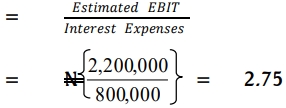
b. i. Interest coverage before the transaction
ii. We solve for the amount (rounded to ₦1,000) by which interest expense can rise without affecting the current BBB rating, i.e. at which the interest coverage ratio is 2.39.
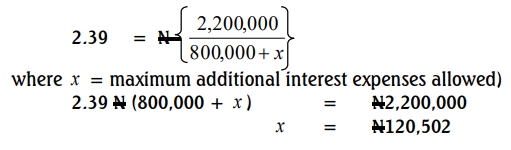
With an annual coupon of 1% up to N12,050,000 (i.e.
𝑁120,502/ 0.01 can be raised without threatening the current rating.
Advantages of Convertible Bonds
Advantages to the Company
- Lower Interest Rate than a Similar Debenture:
- Investors accept a lower interest rate on convertible bonds because they value the option to convert the bonds into equity in the future.
- Tax-Deductible Interest:
- As convertible bonds are a form of debt, the interest payments are considered a business expense and can reduce taxable profit.
- Self-Liquidating:
- When the share price rises to a level where conversion becomes attractive, bonds are exchanged for shares. This relieves the company of the need to repay the loan principal in cash, benefiting cash flow.
- However, this conversion could dilute the earnings per share (EPS) of existing shareholders.
- Fewer Restrictive Covenants:
- Convertible bonds typically come with fewer operational and financial restrictions compared to secured debentures.
- Investors recognize that convertible bonds are a hybrid form of finance, leading to greater flexibility for management and fewer demands for high security or strict covenants.
- Option for Raising Equity at Better Valuation:
- A company that believes its shares are temporarily undervalued may opt for convertible bonds as a way to raise equity indirectly over the medium term.
- If the share price appreciates as expected, the bonds will convert into equity at a favorable valuation, minimizing dilution.
Advantages to the Investors
- Flexibility to Wait and See:
- Investors can observe how the company performs and how its share price evolves before deciding to convert the bonds into equity.
- Greater Security in the Short Term:
- Compared to equity, convertible bonds provide greater security for the principal investment. The fixed interest coupon typically offers a higher yield than dividends from equity.
- Guaranteed Minimum Annual Income:
- Until conversion, investors enjoy a fixed annual income in the form of interest payments.
- Potential for Capital Gains:
- Investors benefit from potential capital gains if the company’s share price rises significantly, allowing them to convert bonds into shares at an advantageous rate and realize a profit.