
Question
Pako Plc. will soon announce a take-over bid for Ronke Tina (RT) Plc., a company in the same industry. The initial bid will be an all-share bid of four Pako shares for every five RT Plc. shares. The most recent annual data relating to the two companies are shown below:
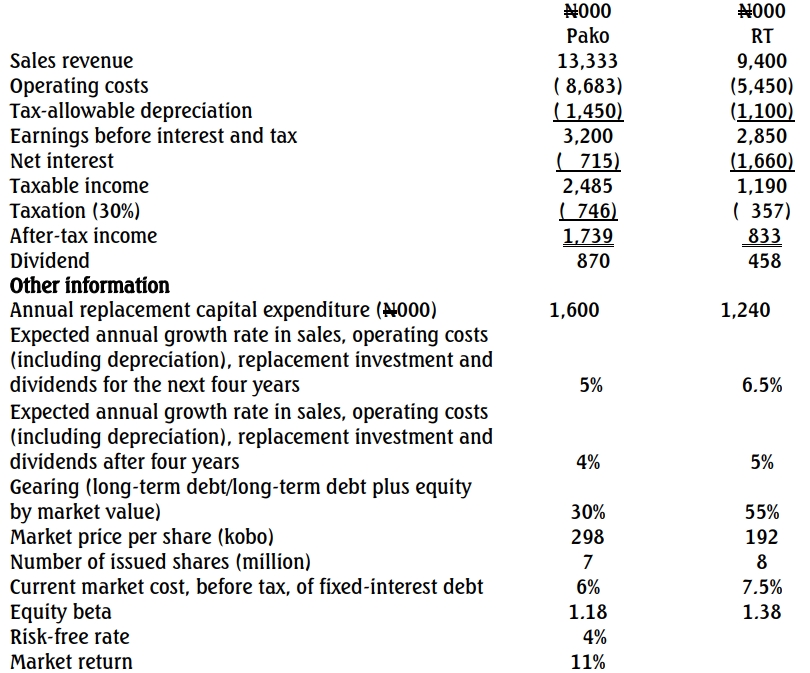
The take-over is expected to result in cost saving in advertising and distribution, reducing the operating costs (including depreciation) of Pako from 76% of sales to 70% of sales. The growth rate of the combined company is expected to be 6% per year for four years and 5% per year thereafter. RT’s debt obligations will be taken over by Pako. The corporate tax rate is expected to remain at 30%.
Sales and costs relevant to the decision may be assumed to be in cash terms.
Required:
a. Estimate how much synergy is expected to be created from the take-over, using free cash flow to the firm analysis for each individual company and the potential combined company. State clearly any assumptions that you make.
Note: The weighted average cost of capital of the combined company is assumed to be 9%. (20 Marks)
b. Discuss any five limitations of the above estimates. (5 Marks)
c. Explain, generally, three advantages and two disadvantages of expansion through merger and acquisition rather than through organic growth. (5 Marks)
(Total: 30 Marks)
Answer
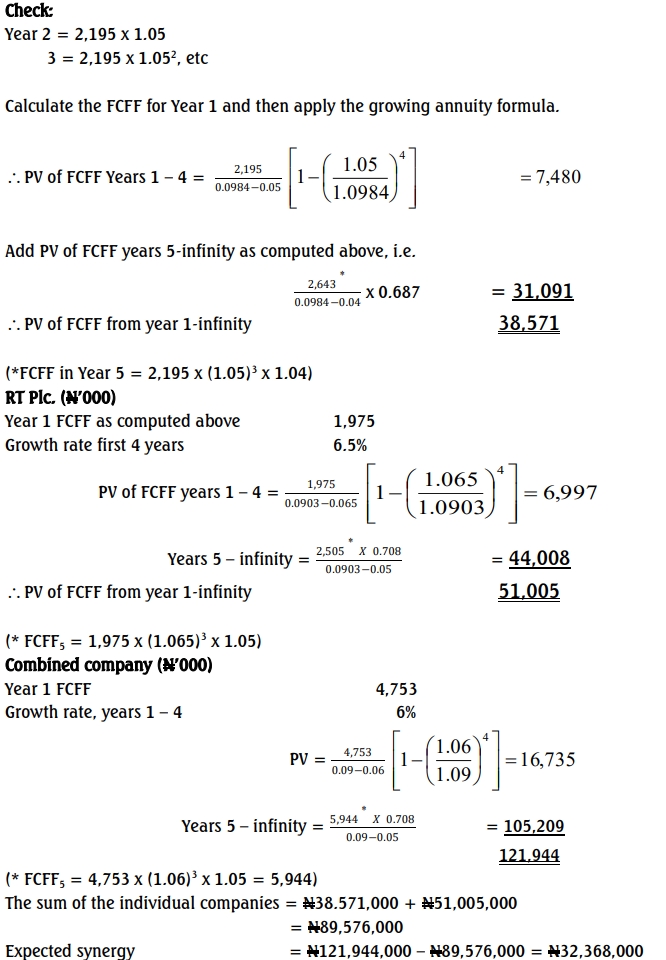
a) A faster method of computing the present value of the FCFF for the first 4 years and for each of the 3 valuations is to use growing annuity.
Pako Plc. N‟000)
Every component of the FCFF calculations grows by 5%. Therefore, the FCFF must grow by the same 5%.
b. Limitations of the Estimates
- Assumption Dependency: The model assumes precise growth rates, tax rates, and cost savings which may vary in reality.
- Exclusion of Integration Costs: Costs associated with merging the two companies are not considered in synergy valuation.
- Market Volatility: Changes in market conditions can impact sales and cost structures.
- Debt Impact: Assumes seamless integration of RT’s higher gearing ratio without adverse effects.
- Forecasting Horizon: Long-term projections may become less reliable after the initial 4-year horizon.
c. Advantages and Disadvantages of Mergers and Acquisitions
Advantages
- Quick Market Expansion: Provides immediate access to new markets and customer bases.
- Cost Synergies: Reduction in duplicated functions such as advertising, distribution, and administrative overheads.
- Increased Market Power: Larger scale improves bargaining power with suppliers and customers.
Disadvantages
- Cultural Misalignment: Integration of different organizational cultures can lead to inefficiencies.
- High Initial Costs: Legal fees, advisory costs, and financing for acquisitions can be significant.