1. Build Nigeria Plc. (BNP) is a giant construction company with head office in Kano, Nigeria. It is involved in construction of roads, dams, airfields, etc., in many parts of the country. Recently, the company won construction contracts across a number of African countries. One of the contracts is for the construction of a dam for a country in Central Africa whose currency is Central African Dollar (C$). The dam has now been completed, and the retention money of C$210,000,000 is due for settlement in one year’s time.
    The current spot exchange rate is C$40 = N1. Risk-free rate is 5% in Nigeria and 25% in the foreign country.
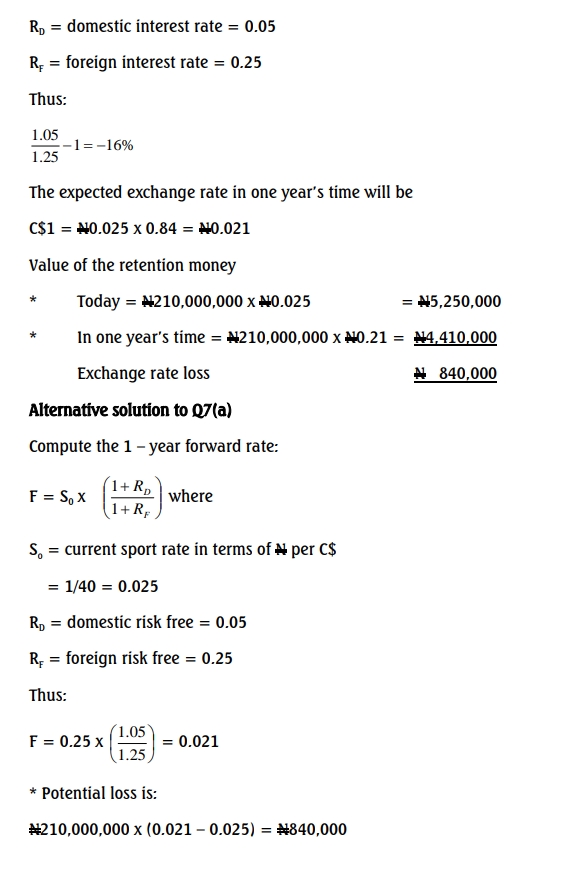
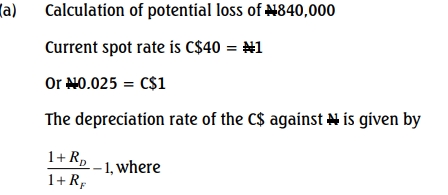
    The Chief Finance Officer (CFO) of BNP is worried about the above financial statistics and concluded that BNP will lose as much as N840,000 due to exchange rate movements between now and the end of the year when the retention money is received.

    Required:
    Explain, showing all relevant calculations, how the CFO arrived at the potential loss of N840,000. (4 Marks)

    b. In another contract in a country in the ECOWAS sub-region (with currency of W$), BNP expects the following payment and receipt in six months’ time:
    You are provided with the following financial data:

    • Spot exchange rate:
      N per W$1 = 1.4735 – 1.4755
    • Money Market Rates:
      Deposit % Borrowing %
      Nigeria 13.25
      West African Country 6.5

    Required:
    Show how BNP can make use of money market hedge to mitigate the foreign exchange risk inherent in the above payment and receipt. Show all workings and the necessary steps.

    (7 Marks)

    c. Discuss TWO advantages and TWO disadvantages of forward exchange contracts.

    (4 Marks)
b. Determine the Amount of W$ to Borrow:

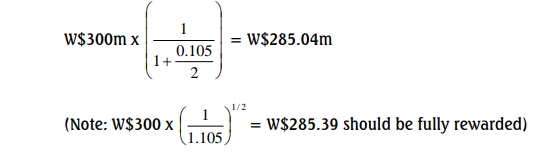
  • Since the foreign asset (net receivable) is W$300m, borrow an amount today that will grow to W$300m after six months at the borrowing rate of 10.5% p.a.

Convert the Borrowed Sum into Naira:

  • The borrowed amount in W$ today is W$285.04m.
  • Use the spot bid rate (bank’s buying rate) of N1.4735 per W$1 for conversion.

This amount, N420.01m, represents the proceeds in Naira from converting the borrowed W$ amount at the current exchange rate. This Naira sum will then be invested in the domestic market to generate the required future value.

 (iv): Settle the Loan and Collect the Naira Proceeds

  1. Repay the Loan Using the W$ Receivable:
    • At the end of six months, the borrowed W$285.04m grows to W$300m, including interest at the borrowing rate of 10.5% p.a.
    • The W$300m receivable is used to fully settle this loan and accrued interest, ensuring no foreign exchange risk remains.
  2. Collect the Naira Deposit Proceeds:
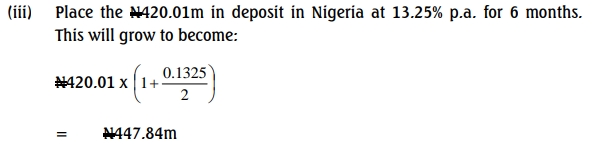
    • The Naira amount invested domestically (N420.01m) grows at a deposit rate of 13.25% p.a. for six months.

Outcome of the Money Market Hedge:

  • The foreign currency asset (W$300m receivable) is effectively converted into a domestic currency asset (N447.84m).
  • This approach eliminates exposure to foreign exchange risk by locking in the domestic value of the foreign receivable, regardless of future exchange rate fluctuations.

c. Advantages and Disadvantages of Forward Exchange Contracts

Advantages:

  1. Eliminates Currency Risk:
    • Locks in exchange rate, protecting against unfavorable currency fluctuations.
  2. Flexibility in Cash Flow Management:
    • Contracts can match payment or receipt dates, ensuring alignment with cash flows.

Disadvantages:

  1. Risk of Opportunity Loss:
    • If exchange rates move favorably, the company cannot benefit from the better rates.
  2. Potential Counterparty Default:
    • Since no money changes hands upfront, there’s a risk of non-performance by the counterparty.