- 20 Marks
Question
Tinco Limited (TL) is considering an expansion project. The project will involve the acquisition of an automated production machine costing ₦11,000,000 and payable now. The machine is expected to have a disposal value at the end of 5 years, which is equal to 10% of the initial expenditure.
The following schedule reflects a recent market survey regarding the estimated annual sales revenue from the expansion project over the project’s five-year life:
| Level of Demand | ₦’000 | Probability |
|---|---|---|
| High | 16,000 | 0.25 |
| Medium | 12,000 | 0.50 |
| Low | 8,000 | 0.25 |
It is expected that the contribution to sales ratio will be 50%. Additional expenditure on fixed overheads is expected to be ₦1,800,000 per annum. TL incurs a 20% tax rate on corporate profits. Corporate tax is paid one year in arrears.
TL’s after-tax nominal (money) discount rate is 15.5% per annum. A uniform inflation rate of 5% per annum will apply to all costs and revenues during the life of the project. All of the values above have been expressed in terms of current prices.
You can assume that all cash flows occur at the end of each year and that the initial investment does not qualify for capital allowances.
Required:
a.
i. Evaluate the proposed expansion from a financial perspective. (10 Marks)
ii. Calculate and interpret the sensitivity of the project to changes in:
- The expected annual contribution (3 Marks)
- The tax rate (2 Marks)
b.
You have now been advised that the capital cost of the expansion will qualify for written down allowances at the rate of 25% per annum on a reducing balance basis. Also, at the end of the project’s life, a balancing charge or allowance will arise equal to the difference between the scrap proceeds and the tax written down value.
You are required to calculate the financial impact of these allowances. (5 Marks)
Answer
a) i)
Expected annual sales (₦000) = (16,000 × 0.25) + (12,000 × 0.5) + (8,000 × 0.25) = ₦12,000
Expected annual contribution = ₦12,000 × 0.5 = ₦6,000
Expected annual cash profit = ₦6,000 – 1,800 = ₦4,200
All the above figures are in real terms. Due to the one-year delay in the
payment of tax, the cash profits will be converted to money cash flows and
tax calculated on the money cash profits. The money cash profits are
expected to grow annually by the rate of inflation of 5%.
Calculation of NPV (₦000)
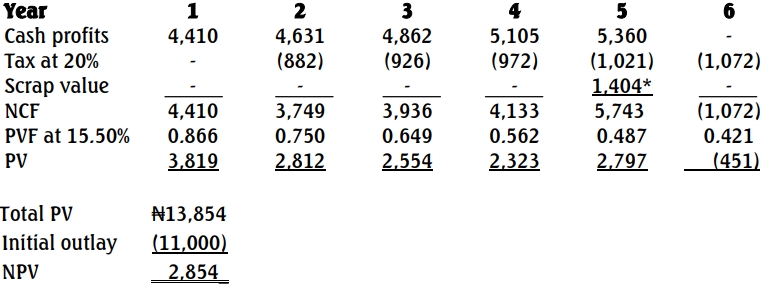
(* = 1,100 × (1.05)5 = ₦1,404)
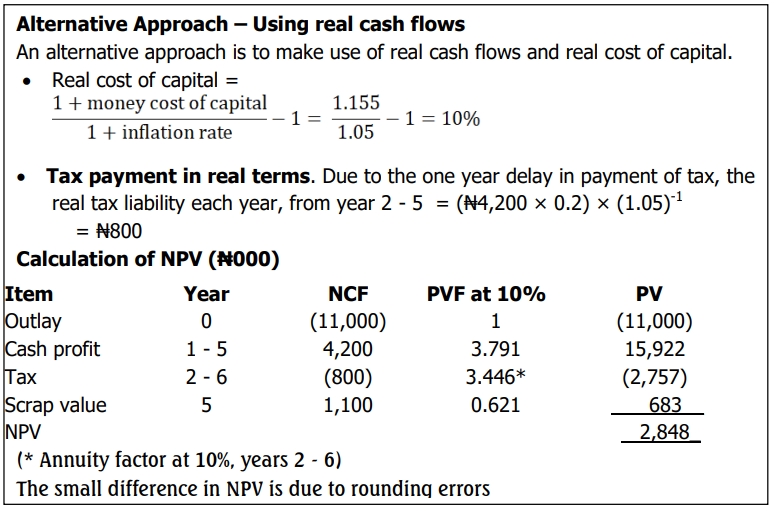
Recommendation
The project has a positive NPV and if other factors are held constant, it should
be accepted.
ii) Sensitivity – contribution
– Using real cash flows approach (₦000)
Annual real contribution = ₦6,000
Related annual real tax (Years 2 – 6) = ₦6,000 × 0.2 × (1.05)-1 = ₦1,143
Calculation of present value
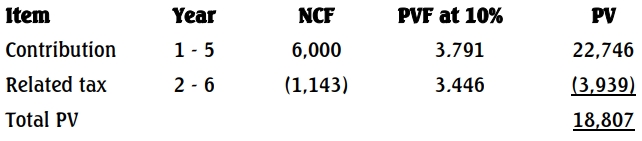
Sensitivity = NPV/PV of contribution = ₦2,848/₦18,807 = 15.14%
This means that the total annual contribution can drop by maximum of 15.14% to avoid negative NPV.
Thus, the minimum annual contribution = ₦6,000,000 × (100% – 15.14%) = ₦5,091,600.
Sensitivity – tax rate
– Using real cash approach (₦000)
Sensitivity = NPV/PV of tax
= ₦2,848/2,757 = 103.30%
This means that the tax rate can increase by maximum of 103.30% if the project is to remain viable. The maximum tax rate is therefore: 20% × (100% + 103.30%) = 40.66%.
This means that if the project is to remain viable, the maximum tax rate allowed is 40.66%
b) Computation of written down allowances
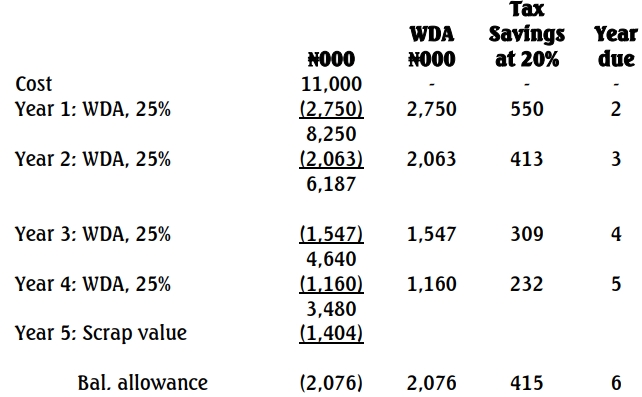
Calculation of PV (₦000)

Total PV = ₦1,143 or ₦1,143,000
This means that the NPV of the project will increase by ₦1,143,000 as a result of tax savings associated with written down allowances.
- Tags: Capital Budgeting, Discount rate, NPV, Sensitivity Analysis, Tax Allowances
- Level: Level 3
- Uploader: Kofi